


Page 113 - TD-3-4
P. 113
Tumor Discovery                                                   Bioinformatics insights into CCL2 mutations


                         A                                  B


                         C                                  D


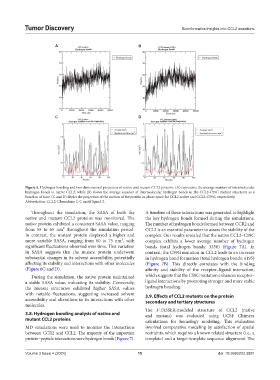
            Figure 5. Hydrogen bonding and two-dimensional projection of native and mutant CCL2 proteins. (A) represents the average number of intermolecular
            hydrogen bonds in native CCL2, while (B) shows the average number of intermolecular hydrogen bonds in the CCL2-C59G mutant structures as a
            function of time. (C and D) depict the projection of the motion of the protein in phase space for CCL2-native and CCL2-C59G, respectively.
            Abbreviation: CCL2: Chemokine C-C motif ligand 2.

              Throughout the simulation, the SASA of both the   A timeline of these interactions was generated to highlight
            native and mutant CCL2 proteins was monitored. The   the key hydrogen bonds formed during the simulations.
            native protein exhibited a consistent SASA value, ranging   The number of hydrogen bonds formed between CCR2 and
            from 55 to 65 nm² throughout the simulation period.   CCL2 is an essential parameter to assess the stability of the
            In contrast, the mutant protein displayed a higher and   complex. Our results revealed that the native CCL2–C59C
            more variable SASA, ranging from 60 to 75 nm², with   complex exhibits a lower average number of hydrogen
            significant fluctuations observed over time. This variation   bonds (total hydrogen bonds: 3350) (Figure  7A). In
            in SASA suggests that the mutant protein underwent   contrast, the C59G mutation in CCL2 leads to an increase
            substantial changes in its solvent accessibility, potentially   in hydrogen bond formation (total hydrogen bonds: 4195)
            affecting its stability and interactions with other molecules   (Figure  7B). This directly correlates with the binding
            (Figure 6C and D).                                 affinity and stability of the receptor–ligand interaction,
              During the simulation, the native protein maintained   which suggests that the C59G mutation enhances receptor–
            a stable SASA value, indicating its stability. Conversely,   ligand interactions by promoting stronger and more stable
            the mutant structures exhibited higher SASA values   hydrogen bonding.
            with notable fluctuations, suggesting increased solvent   3.9. Effects of CCL2 mutants on the protein
            accessibility and alterations in its interactions with other   secondary and tertiary structures
            molecules.
                                                               The I-TASSER-modeled structure of CCL2 (native
            3.8. Hydrogen bonding analysis of native and       and mutant) was evaluated using UCSF Chimera
            mutant CCL2 proteins                               calculations for homology modeling. This evaluation
            MD  simulations  were  used  to  monitor  the  interactions   involved comparative modeling by satisfaction of spatial
            between  CCR2  and  CCL2.  The  majority of  the important   restraints, which requires a known related structure (i.e., a
            protein–peptide interactions were hydrogen bonds (Figure 7).   template) and a target-template sequence alignment. The


            Volume 3 Issue 4 (2024)                         15                                doi: 10.36922/td.3891

