


Page 112 - TD-3-4
P. 112
Tumor Discovery                                                   Bioinformatics insights into CCL2 mutations


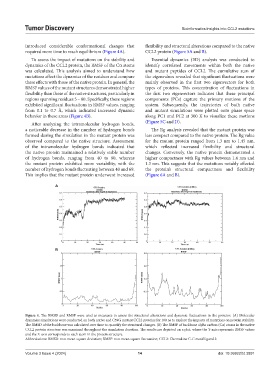
            introduced considerable conformational changes that   flexibility and structural alterations compared to the native
            required more time to reach equilibrium (Figure 4A).  CCL2 protein (Figure 5A and B).
              To assess the impact of mutations on the stability and   Essential dynamics (ED) analysis was conducted to
            dynamics of the CCL2 protein, the RMSF of the Cα atoms   identify correlated movements within both the native
            was calculated. This analysis aimed to understand how   and mutant peptides of CCL2. The cumulative sum of
            mutations affect the dynamics of the residues and compare   the eigenvalues revealed that significant fluctuations were
            these effects with those of the native protein. In general, the   mainly observed in the first two eigenvectors for both
            RMSF values of the mutant structures demonstrated higher   types of proteins. This concentration of fluctuations in
            flexibility than those of the native structures, particularly in   the first two eigenvectors indicates that these principal
            regions spanning residues 5 – 80. Specifically, these regions   components (PCs) capture the primary motions of the
            exhibited significant fluctuations in RMSF values, ranging   system. Subsequently, the trajectories of both native
            from 0.1 to 0.7 Å, which indicated increased dynamic   and mutant simulations were plotted onto phase space
            behavior in these areas (Figure 4B).               along PC1 and PC2 at 300 K to visualize these motions
              After  analyzing  the  intramolecular  hydrogen  bonds,   (Figure 5C and D).
            a noticeable decrease in the number of hydrogen bonds   The Rg analysis revealed that the mutant protein was
            formed during the simulation in the mutant protein was   less compact compared to the native protein. The Rg value
            observed compared to the native structure. Assessment   for the mutant protein ranged from 1.3 nm to 1.45 nm,
            of the intramolecular hydrogen bonds indicated that   which  reflected  increased  flexibility  and  structural
            the native protein maintained a relatively stable number   changes.  Conversely,  the  native  protein  demonstrated  a
            of hydrogen bonds, ranging from 40 to 80, whereas   higher compactness with Rg values between 1.4 nm and
            the mutant protein exhibited more variability, with the   1.3 nm. This suggests that the mutations notably affected
            number of hydrogen bonds fluctuating between 40 and 69.   the protein’s structural compactness and flexibility
            This implies that the mutant protein underwent increased   (Figure 6A and B).

                         A


                         B


            Figure 4. The RMSD and RMSF were used as measures to assess the structural alterations and dynamic fluctuations in the proteins. (A) Molecular
            dynamics simulations were conducted on both native and C59G mutant CCL2 proteins for 100 ns to explore the impacts of mutations on protein stability.
            The RMSD of the backbone was calculated over time to quantify the structural changes. (B) The RMSF of backbone alpha carbon (Cα) atoms in the native
            CCL2 protein structure was examined throughout the simulation duration. The results are depicted on a plot, where the Y-axis represents RMSF values
            and the X-axis corresponds to each atom in the protein structure.
            Abbreviations: RMSD: root mean square deviation; RMSF: root mean square fluctuation; CCL2: Chemokine C-C motif ligand 2.


            Volume 3 Issue 4 (2024)                         14                                doi: 10.36922/td.3891

