


Page 129 - TD-3-4
P. 129
Tumor Discovery                                                     CTC characterization for EGFR mutations


            fwd-GCTGGTAACATCCACCCAGA           rev-TTATCTC     able to capture EpCAM-positive cells (Figure 2). Having
            CCCTCCCCGTATC (261  bp); exon 20: fwd-CACA CT      established the optimal parameters for collection, the
            GACGTGCCTCTCC        rev-TTATCTCCCCTCCCCGTA        CTCs from PC-9 were analyzed for mutations in 4 exons of
            TC (251  bp); exon 21: fwd-AGCCATAAGTCCTCG         the EGFR gene. Figure 3A shows the gene amplification of
            ACGTG rev-CCTGGTGTCAGGAAAATGCT (320  bp)           each exon independently using gDNA obtained from the
            (primer sequences were obtained from Stab Vida Genetics   PC-9 cell line, showing that all mutations were detectable.
            Laboratory, Portugal). Genomic DNA (3 µL) was added to   Figure 3B shows a multiplex PCR using the same primers
            47 µL of standard PCR mix (provided by Stab Vida Genetics   on cells isolated from experiments where the PC-9 cells
                                                                                                            6
            Laboratory, Portugal) Thermocycling temperatures were as   were spiked into media at various concentrations (1 × 10 ,
                            .
                                                                    5
                                                                          4
                                                                                    3
            follows: initial denaturing at 98 °C for 15 min, then 40 cycles   2 × 10 , 4 × 10 , and 8 × 10  cells/mL).
            of denaturation at 94 °C for 30 s, annealing at 58 °C for 1 min,   3.2. Isolation of EpCAM-positive cells from the blood
            and amplification at 75 °C for 1 min, with a final elongation   of patients with NSCLC
            step at 70 °C for 5 min. PCR products were evaluated using gel
            electrophoresis on 2% (w/v) agarose gel.           CTCs  isolated  from  the  blood  of  patients  were
                                                               immunostained to identify markers of epithelial cells and
            2.11. Next-generation sequencing (NGS) to          ensure that the cells isolated were tumor-derived. Figure 4A
            determine exon 18 – 21 mutations in patient        shows a brightfield image of a clump of cells and beads
            samples                                            isolated  from  the patient’s  blood.  Figure  4B  shows  that
            Amplicon and library generation were performed according   the isolated cells were tumor-derived as the clump stained
            to the procedure of Nextera XT (15031942)  (Illumina,   well with a pan-cytokeratin antibody (which stains for
            USA). The amplicon generated was sequenced using an   epithelial-derived cells). Figure 4C shows that only a few
            Illumina sequencer, with the data being processed using   cells stained positive for CD45 antigen using rhodamine-
            Trim galore (version 0.4.3.1) and Prinseq (version 0.20.4).   conjugated mouse anti-human CD45 antibodies (a marker
            After sorting, data were aligned to the reference with BWA   for hematological cells), most possibly showing a few
            (MEM) version 0.7.17.1. Variants were detected using the   leukocytes co-isolated with the tumor cells.  Figure  4D
            VAR direct version from 07.03.2018 (sequencing was done   shows that most of the cells stained positive for DNA
            at Stab Vida Genetics Laboratory, Portugal).       content using DAPI. Figure 4E presents a merged image
                                                               of the three fluorescence channels, clearly showing that the
            2.12. Statistical analysis                         epithelial tumor cells are the predominant cell type isolated.
            Data were analyzed using Prism version 9.0 (Graph pad   3.3. Patient characteristics
            software, San Diego California USA).
                                                               Fifty-nine patients recruited for the study were diagnosed
            3. Results                                         following a tissue biopsy. Their clinicopathological
                                                               characteristics are shown in  Table  1,  and the process of
            3.1. Device description and validation             recruitment is described in Figure 5.
            The  device was  designed to  isolate  EpCAM-positive
            cells in blood contained within a PMMA device using a
            4.5-µm diameter magnetic bead covalently bound to an
            anti-EpCAM antibody sweeping through the blood on
            a chip (Figure 1). As the magnetic bead sweeps through
            the blood, it binds with any EpCAM-positive cells. The
            movement of the magnetic beads can be attributed to the
            magnetic field generated by NdFeBr magnets attached
            to the electromagnetic arms of the unit. The arm moves
            across the chip in step delays of 6 s to allow sufficient
            time for all magnetized cells to be dragged through the
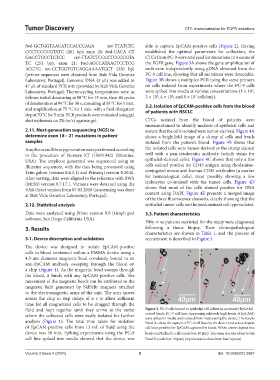
            fluid and kept together until they arrive at the outlet   Figure 2. PC-9 cells bound to epithelial cell adhesion molecule (EpCAM)-
            where the collected cells were easily isolated for further   coated beads. PC-9 cell lines (expressing relatively high levels of EpCAM)
                                                               were spiked in media and isolated from media using the device. The results
            analysis (Figure  1). The total time taken for isolation   Panel A- show the capture of PC-9 cell lines by the device (red arrow depicts
            of  EpCAM-positive  cells  from  13  mL  of  fluid  using  the   cell lines positive for EpCAM captured by beads. White arrow depicts free
            device was 50 min. Spiking experiments using the PC-9   beads unattached to cells (scale bar: 40 µm). The same was also observed in
            cell line spiked into media showed that the device was   Panel B (scale bar: 40 µm) (representative data from four repeats)


            Volume 3 Issue 4 (2024)                         5                                 doi: 10.36922/td.3987

