


Page 131 - TD-3-4
P. 131
Tumor Discovery CTC characterization for EGFR mutations
Table 1. Clinicopathological characteristics of NSCLC
patients who underwent CTC analysis for mutations
N (%)
Age
Mean age 65.4 years
Range 47 – 76 years
Sex
Male 20 (52.6)
Female 18 (47.3)
Smoking status
Unknown 21 (55.3)
Yes 13 (34.2)
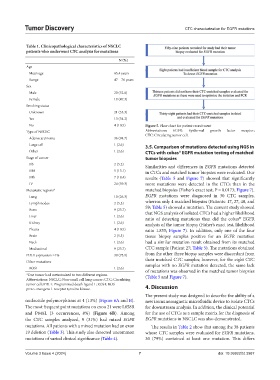
No 4 (10.5) Figure 5. Flow chart for patient recruitment
Type of NSCLC Abbreviations: EGFR: Epidermal growth factor receptor;
CTC: Circulating tumor cell.
Adenocarcinoma 36 (94.7)
Large cell 1 (2.6)
3.5. Comparison of mutations detected using NGS in
Other 1 (2.6) CTCs with cobas EGFR mutation testing of matched
Stage of cancer tumor biopsies
IIb 2 (5.2)
Similarities and differences in EGFR mutations detected
IIIA 5 (13.1) in CTCs and matched tumor biopsies were evaluated. Our
IIIb 7 (18.4) results (Table 5 and Figure 7) showed that significantly
IV 24 (59.3) more mutations were detected in the CTCs than in the
Metastatic regions* matched biopsies (Fisher’s exact test, P = 0.0173; Figure 7).
Lung 10 (26.3) EGFR mutations were diagnosed in 30 CTC samples,
Lymph nodes 2 (5.3) whereas only 4 matched biopsies (Patients: 17, 27, 40, and
Bone 9 (23.7) 59; Table 5) showed a mutation. The current study showed
that NGS analysis of isolated CTCs had a higher likelihood
Liver 1 (2.6)
ratio of detecting mutations than did the cobas EGFR
Kidney 1 (2.6) analysis of the tumor biopsy (Fisher’s exact test, likelihood
Pleura 4 (10.5) ratio 1.855; Figure 7). In addition, only one of the four
Brain 2 (5.3) tissue biopsy samples positive for an EGFR mutation
Neck 1 (2.6) had a similar mutation result obtained from its matched
Mediastinal 9 (23.7) CTC sample (Patient 27; Table 5). The mutations obtained
PDL1 expression ≥1% 30 (78.9) from the other three biopsy samples were discordant from
Other mutations their matched CTC samples; however, for the eight CTC
samples with no EGFR mutation detected, the same lack
ROS1 1 (2.6)
of mutations was observed in the matched tumor biopsies
*One tumor had metastasized to two different regions. (Table 5 and Figure 7).
Abbreviations: NSCLC: Non-small cell lung cancer; CTC: Circulating
tumor cell; PDL1: Programmed death ligand 1; ROS1: ROS 4. Discussion
proto-oncogene 1 receptor tyrosine kinase.
The present study was designed to describe the ability of a
nucleotide polymorphisms at 4 (13%) (Figure 6A and B). new immunomagnetic microfluidic device to isolate CTCs
The most frequent point mutations on exon 21 were L858R for downstream analysis. In addition, the clinical potential
and P848L (3 occurrences, 8%) (Figure 6B). Among for the use of CTCs as a sample matrix for the diagnosis of
the CTC samples analyzed, 9 (31%) had mixed EGFR EGFR mutations in NSCLC was also demonstrated.
mutations. All patients with a mixed mutation had an exon The results in Table 2 show that among the 38 patients
19 deletion (Table 3). This study also detected uncommon whose CTC samples were evaluated for EGFR mutations,
mutations of varied clinical significance (Table 4). 30 (79%) contained at least one mutation. This differs
Volume 3 Issue 4 (2024) 7 doi: 10.36922/td.3987

