


Page 38 - AIH-1-2
P. 38
Artificial Intelligence in Health                                        Blockchain for health-care security


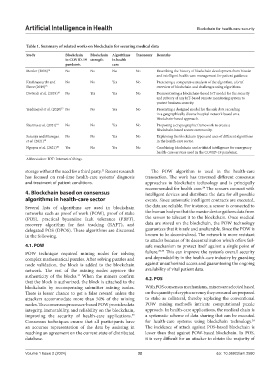
            Table 1. Summary of related works on blockchain for securing medical data
            Study            Blockchain   Blockchain  Algorithms   Taxonomy  Remarks
                             in COVID‑19  strength  in health
                             pandemic            care
            Mettler (2016) 14  No      No        No        No       Describing the history of blockchain development from bitcoin
                                                                    and intelligent health-care management for patient guidance.
            Krishnamurthi and   No     No        Yes       No       Presenting a comparative analysis of the algorithm, a brief
            Shree (2019) 15                                         overview of blockchain and challenges using algorithms.
            Dwivedi et al. (2019) 16  No  Yes    Yes       No       Demonstrating a blockchain-based IoT model for the security
                                                                    and privacy of any IoT-based remote monitoring system to
                                                                    protect business security.
            Yazdinejad et al. (2020) 17  No  No  Yes       No       Presenting a designed model for the safe data recording
                                                                    in a geographically diverse hospital network based on a
                                                                    blockchain-based approach.
            Sharma et al. (2021) 18  No  No      Yes       No       Proposing a cryptographic framework to create a
                                                                    blockchain-based secure community.
            Saranya and Murugan    No  No        Yes       No       Explaining the blockchain types and uses of different algorithms
            et al. (2021) 19                                        in the health-care sector.
            Nguyen et al. (2021) 20  Yes  No     Yes       No       Combining blockchain and artificial intelligence for emergency
                                                                    health-care services used in the COVID-19 pandemic.
            Abbreviation: IOT: Internet of things.

            storage without the need for a third party.  Recent research   The POW algorithm is used in the health-care
                                            31
            has focused on real-time health-care systems’ diagnosis   transaction. The work has traversed different consensus
            and treatment of patient conditions.               approaches in blockchain technology and is principally
                                                               recommended for health care.  The sensors connect with
                                                                                       34
            4. Blockchain based on consensus                   intelligent devices and distribute the data for all possible
            algorithms in health-care sector                   events. Since automatic intelligent contracts are executed,
            Several  lists  of  algorithms  are  used  in  blockchain   the data are reliable. For instance, a sensor is connected to
            networks such as proof of work (POW), proof of stake   the human body so that the master device gathers data from
            (POS), practical byzantine fault tolerance (PBFT),   the sensor to telecast it to the blockchain. Once medical
            recovery algorithm for fast tracking (RAFT), and   data are stored on the blockchain, the POW technology
            delegated POS (DPOS). These algorithms are discussed   guarantees that it is safe and unalterable. Since the POW is
            in the following.                                  known to be decentralized. The network is more resistant
                                                               to attacks because of its decentralization which offers fail-
            4.1. POW                                           safe mechanism to protect itself against a single point of
            POW technique required mining nodes for solving    failure. 29,35  This can improve the system’s overall security
            complex mathematical puzzles. After solving puzzles and   and dependability in the health-care industry by guarding
            node validation, the block is added to the blockchain   against unauthorized access and guaranteeing the ongoing
            network. The rest of the mining nodes approve the   availability of vital patient data.
            authenticity of the blocks.  When the miners confirm   4.2. POS
                                  32
            that the block is authorized, the block is attached to the
            blockchain  by  recompensing  submitter  mining  nodes.   With POS consensus mechanisms, miners are selected based
            There is lesser chance to get a false reward unless the   on the quantity of cryptocurrency they own and are prepared
            attackers accommodate more than 50% of the mining   to stake as collateral, thereby replacing the conventional
            nodes. The consensus processes-based POW provides data   POW mining method’s intricate computational puzzle
            integrity, immutability, and reliability on the blockchain,   approach. In health-care applications, the medical chain is
            improving the  security of  health-care applications.    a systematic scheme of data sharing that can be executed
                                                         33
                                                                                                            34
            Consensus techniques ensure that all participants have   for health-care systems using blockchain technology.
            an accurate representation of the data by assisting in   The incidence of attack against POS-based blockchain is
            reaching an agreement on the current state of distributed   lesser  than  that  against  POW-based  blockchain.  In  POS,
            database.                                          it is very difficult for an attacker to obtain the majority of


            Volume 1 Issue 2 (2024)                         32                               doi: 10.36922/aih.2580

