


Page 83 - AIH-1-4
P. 83
Artificial Intelligence in Health                                 Robotics and Vivaldi AI for ALS assessment


            patients  have  the  flexibility  to  request  repetitions  of   questionnaire administration. This grid also
            questions or take brief pauses using vocal commands. On   documented patient reactions and behaviors.
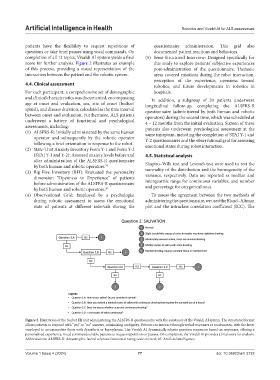
            completion of all 12 topics, Vivaldi AI system yields a final   (5)  Semi-Structured Interview: Designed specifically for
            score for further analysis. Figure 2 illustrates an example   this study to explore patients’ subjective experiences
            of this process, providing a visual representation of the   post-administration of the questionnaire. Thematic
            interaction between the patient and the robotic system.  areas covered emotions during the robot interaction,
                                                                  perception  of  the  experience,  openness  toward
            4.4. Clinical assessment                              robotics, and future developments in robotics in
            For each participant, a comprehensive set of demographic   hospitals.
            and clinical characteristics was documented, encompassing   In addition, a subgroup of 20  patients underwent
            age at onset  and evaluation, sex, site of onset (bulbar/  longitudinal follow-up, completing the ALSFRS-R
            spinal), and disease duration, calculated as the time interval   questionnaire (administered by both human and robotic
            between onset and evaluation. Furthermore, ALS patients   operators) during the second time, which was scheduled at
            underwent a battery of  functional and psychological   4 – 12 months from the initial evaluation. Sixteen of these
            assessments, including:                            patients also underwent psychological assessment at the
            (1)  ALSFRS-R: Initially administered by the same human   same timepoint, including the completion of STAI Y-1 and
               operator and  subsequently by  the  robotic  operator   Y-2 questionnaires and the observational grid for assessing
               following a brief orientation in response to the robot.
            (2)  State-Trait Anxiety Inventory Form Y-1 and Form Y-2   emotional states during robot interaction.
               (STAI Y-1 and Y-2): Assessed anxiety levels before and   4.5. Statistical analysis
               after administration of the ALSFRS-R questionnaire   Shapiro–Wilk test and Levene’s test were used to test the
               by both human and robotic operators. 29
            (3)  Big Five Inventory (BFI): Evaluated the personality   normality of the distribution and the homogeneity of the
               dimension  “Openness  to  Experience”  of  patients   variance, respectively. Data are reported as median and
               before administration of the ALSFRS-R questionnaire   interquartile range for continuous variables, and number
               by both human and robotic operators. 30         and percentage for categorical ones.
            (4)  Observational Grid: Employed by a psychologist   To assess the agreement between the two methods of
               during robotic assessment to assess the emotional   administering the questionnaire, we used the Bland–Altman
               state of patients at different intervals during the   plot and the intraclass correlation coefficient (ICC). The


            Figure 2. Illustration of the Sanbot Elf unit administering the ALSFRS-R questionnaire with the assistance of the Vivaldi AI system. The structured format
            allows patients to respond with “yes” or “no” answers, minimizing ambiguity. Patients can interact through verbal responses or touchscreen, with the latter
            employed to accommodate those with dysarthria or hypophonia. The Vivaldi AI dynamically adjusts question sequences based on responses, offering a
            personalized experience. Vocal commands enable patients to request repetitions or pauses. On completion, the Vivaldi AI provides a final score for analysis.
            Abbreviations: ALSFRS-R: Amyotrophic lateral sclerosis functional rating scale-revised; AI: Artificial intelligence.


            Volume 1 Issue 4 (2024)                         77                               doi: 10.36922/aih.3732

