


Page 85 - AIH-1-4
P. 85
Artificial Intelligence in Health                                 Robotics and Vivaldi AI for ALS assessment


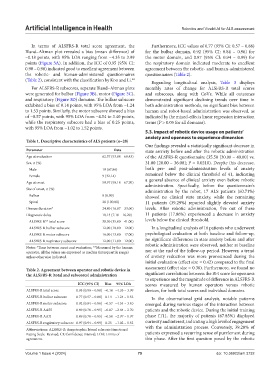
              In terms of ALSFRS-R total score agreement, the    Furthermore, ICC values of 0.77 (95% CI: 0.57 – 0.88)
            Bland–Altman plot revealed a bias (mean difference) of   for  the  bulbar  domain,  0.92  (95%  CI:  0.84  –  0.96)  for
            −0.18 points, with 95% LOA ranging from −4.35 to 3.99   the motor domain, and 0.97  (95% CI: 0.94 – 0.99) for
            points (Figure 3A). In addition, the ICC of 0.95 (95% CI:   the respiratory domain indicated moderate to excellent
            0.90 – 0.98) indicated good to excellent agreement between   agreement between the robotic- and human-administered
            the robotic-  and human-administered questionnaires   questionnaires (Table 2).
            (Table 2), consistent with the classification by Koo and Li. 34
                                                                 Regarding longitudinal analysis,  Table 3 displays
              For ALSFRS-R subscores, separate Bland–Altman plots   monthly rates of change for ALSFRS-R total scores
            were generated for bulbar (Figure 3B), motor (Figure 3C),   and subscores, along with CoVs. While all outcomes
            and respiratory (Figure 3D) domains. The bulbar subscore   demonstrated significant declining trends over time in
            exhibited a bias of 0.14 points, with 95% LOA from −1.24   both administration methods, no significant bias between
            to 1.53 points. Similarly, the motor subscore showed a bias   human and robot-based administration was observed, as
            of −0.57 points, with 95% LOA from −4.54 to 3.40 points,   indicated by the mixed-effects linear regression interaction
            while the respiratory subscore had a bias of 0.25 points,   terms (P > 0.05 for all domains).
            with 95% LOA from −1.02 to 1.52 points.
                                                               5.3. Impact of robotic device usage on patients’
                                                               anxiety and openness to experience dimension
            Table 1. Descriptive characteristics of ALS patients (n=28)
                                                               Our findings revealed a statistically significant decrease in
            Parameter                            Data          state anxiety before and after the robotic administration
            Age at evaluation                62.37 (53.88 – 68.43)  of the ALSFRS-R questionnaire (35.50 [30.00 – 40.00] vs.
            Sex, n (%)                                         31.00 [28.00 – 36.00]; P = 0.0218). Despite this decrease,
             Male                            19 (67.86)        both pre-  and post-administration levels of anxiety
             Female                          9 (32.14)         remained below the clinical threshold of 41, indicating
            Age at onset                     59.97 (50.18 – 67.70)  a general absence of clinical anxiety even before robotic
                                                               administration. Specifically, before the questionnaire’s
            Site of onset, n (%)                               administration by the robot, 17 ALS patients (60.71%)
             Bulbar                          0 (0.00)          showed no clinical state anxiety, while the remaining
             Spinal                          28 (100.00)       11  patients (39.29%) reported slightly elevated anxiety
            Disease duration*                24.80 (16.87 – 33.60)  levels. After robotic administration, five out of these
            Diagnostic delay                 10.13 (7.10 – 16.20)  11  patients (17.86%) experienced a decrease in anxiety
             ALSFRS-R** total score          38.50 (35.00 – 41.00)  levels below the clinical threshold.
             ALSFRS-R bulbar subscore        12.00 (10.00 – 12.00)  In a longitudinal analysis of 16 patients who underwent
             ALSFRS-R motor subscore         16.00 (13.00 – 17.00)  psychological evaluation at both baseline and follow-up,
             ALSFRS-R respiratory subscore   12.00 (11.00 – 12.00)  no significant differences in state anxiety before and after
            Notes: *Time between onset and evaluation; **Measured by the human   robotic administration were observed, neither at baseline
            operator; all the values are expressed as median (interquartile range)   nor at the end of the follow-up period. However, a trend
            unless otherwise indicated.                        of anxiety reduction was more pronounced during the
                                                               initial evaluation (effect size = 0.42) compared to the final
            Table 2. Agreement between operator and robotic device in   assessment (effect size = 0.36). Furthermore, we found no
            the ALSFRS‑R (total and subscores) administration  significant correlations between the BFI score for openness
                                                               to experience and the magnitude of difference in ALSFRS-R
                                  ICC (95% CI)  Bias  95% LOA  scores measured by human operators versus robotic
            ALSFRS-R total score  0.95 (0.90 – 0.98) −0.18 −4.35 – 3.99  devices, for both total scores and individual domains.
            ALSFRS-R bulbar subscore  0.77 (0.57 – 0.88) 0.14 −1.24 – 1.53  In  the observational  grid  analysis,  notable  patterns
            ALSFRS-R motor subscore  0.92 (0.84 – 0.96) −0.57 −4.54 – 3.40  emerged during various stages of the interaction between
            ALSFRS-R AASS        0.89 (0.78 – 0.95) −0.07 −2.84 – 2.70  patients and the robotic device. During the initial training
            ALSFRS-R AAII        0.89 (0.78 – 0.95) −0.50 −2.97 – 1.97  phase (T1), the majority of patients (67.85%)  displayed
            ALSFRS-R respiratory subscore 0.97 (0.94 – 0.99) 0.25 −1.02 – 1.52  curiosity and interest, indicating a high level of engagement
            Abbreviations: ALSFRS-R: Amyotrophic lateral sclerosis Functional   with the administration process. Conversely, 39.28% of
            Rating Scale–Revised; CI: Confidence interval; LOA: Limits of   patients expressed a recurring sense of puzzlement during
            agreement.                                         this phase. After the first question posed by the robotic


            Volume 1 Issue 4 (2024)                         79                               doi: 10.36922/aih.3732

