


Page 86 - AIH-1-4
P. 86
Artificial Intelligence in Health                                 Robotics and Vivaldi AI for ALS assessment


                         A                                  B


                         C                                   D


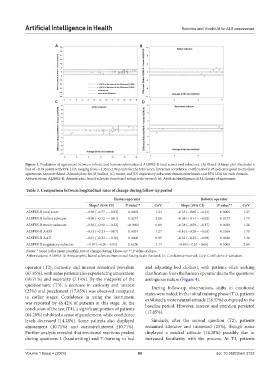
            Figure 3. Evaluation of agreement between robotic and human-administered ALSFRS-R total scores and subscores. (A) Bland–Altman plot illustrates a
            bias of −0.18 points with 95% LOA ranging from −4.35 to 3.99 points for the total score. Intraclass correlation coefficient of 0.95 indicates good to excellent
            agreement. Separate Bland–Altman plots for (B) bulbar, (C) motor, and (D) respiratory subscores demonstrate biases and 95% LOA for each domain.
            Abbreviations: ALSFRS-R: Amyotrophic lateral sclerosis functional rating scale-revised; AI: Artificial intelligence; LOA: Limits of agreement.

            Table 3. Comparison between longitudinal rates of change during follow‑up period
                                                 Human operator                       Robotic operator
                                       Slope* (95% CI)  P‑value**  CoV        Slope (95% CI)  P‑value**  CoV
            ALSFRS-R total score      −0.50 (−0.77 – −0.23)  0.0002  1.24   −0.55 (−0.86 – −0.24)  0.0006  1.27
            ALSFRS-R bulbar subscore  −0.06 (−0.12 – −0.01)  0.0273  2.00   −0.08 (−0.14 – −0.02)  0.0137  1.75
            ALSFRS-R motor subscore   −0.36 (−0.50 – −0.22)  <0.0001  0.89  −0.38 (−0.59 – −0.17)  0.0020  1.26
            ALSFRS-R AASS             −0.15 (−0.23 – −0.07)  0.0034  1.27   −0.16 (−0.28 – −0.03)  0.0166  1.75
            ALSFRS-R AAII             −0.21 (−0.32 – −0.10)  0.0008  0.95   −0.22 (−0.35 – −0.09)  0.0028  1.36
            ALSFRS-R respiratory subscore  −0.07 (−0.20 – 0.05)  0.6250  4.14  −0.09 (−0.24 – 0.06)  0.5000  3.89
            Notes: * Slope is the mean monthly rate of change during follow-up; ** P value of slope.
            Abbreviations: ALSFRS-R: Amyotrophic lateral sclerosis Functional Rating Scale-Revised; CI: Confidence interval; CoV: Coefficient of variation.

            operator (T2), curiosity and interest remained prevalent   and adjusting bed clothes), with patients often seeking
            (67.85%), with some patients also experiencing amusement   clarification from the human operator due to the questions’
            (10.71%) and neutrality (7.14%). By the midpoint of the   ambiguous nature (Figure 4).
            questionnaire (T3), a decrease in curiosity and interest   During  follow-up  observations,  shifts  in  emotional
            (25%) and puzzlement (17.85%) was observed compared   states were noted. In the initial training phase (T1), patients
            to earlier stages. Confidence in using the instrument
            was reported by 46.42% of patients at this stage. At the   exhibited a more neutral attitude (28.57%) compared to the
                                                               baseline period. However, interest and attention persisted
            conclusion of the test (T4), a significant portion of patients   (17.85%).
            (64.28%) exhibited a sense of puzzlement, while confidence
            levels decreased (14.28%). Some patients also displayed   Similarly, after the second question (T2), patients
            amusement (10.71%) and curiosity/interest (10.71%).   remained attentive and interested (25%), though some
            Further analysis revealed that emotional reactions peaked   displayed  a  neutral  attitude  (14.28%)  possibly  due  to
            during questions 4 (handwriting) and 7 (turning in bed   increased familiarity with the process. At T3, patients


            Volume 1 Issue 4 (2024)                         80                               doi: 10.36922/aih.3732

