


Page 167 - AJWEP-22-4
P. 167
Land suitability for coffee Abaya and Gelana

                highly suitable (1200 – 1400 mm), 15.2% moderately   respectively.  In  Gelana,  31  –  32°C  is  considered
                suitable (1400 – 1900 mm), 55.2% marginally suitable   highly suitable, 32 – 32.5°C moderately suitable,
                (1050 – 1200 mm), 17.1% not suitable (860 – 1050 mm),   32.5 – 33°C marginally suitable, and > 33°C unsuitable
                and 3.7% permanently  not suitable (470 – 860  mm).   for coffee production, with 5.8%, 21.6%, 46.9%, and
                In Gelana, the classifications are 16% highly suitable,   25.4% of land falling in these categories, respectively
                26.6% moderately suitable, 32.4% marginally suitable,   (Table 3 and Figure A2).
                20.5% not suitable, and 3.3% permanently  not
                suitable. These results are consistent with recent agro-  3.1.2. Elevation and slope
                ecological  research  indicating  that  coffee  grows  best   Elevation  influences  three  important  variables
                with 1200 – 2000 mm of evenly distributed rainfall.    for  Arabica  coffee:  temperature,  humidity,  and
                                                               15
                While Abaya’s challenges necessitate focused support,   rainfall.   According to regional standards, the study
                                                                           53
                Gelana’s  higher  suitability  offers  greater  potential  for   categorizes  elevations  of 1200 – 1600  m as highly
                adaptive investments. Permanently unsuitable areas in   suitable, 1600 – 2000  m  as moderately  suitable, and
                both districts highlight the need for alternative drought-  2000 – 2300  m as marginally acceptable. Heat and
                tolerant livelihoods and climate-resilient planning.  low humidity make areas below 1200 m unsuitable for
                  Optimal agricultural production depends on specific   Arabica coffee production.  In Abaya, 56.1% of the area
                                                                                           54
                rainfall and temperature conditions.  In the study area,   has < 5% slopes; in Gelana, it is 56.2%. Both districts
                                                1
                rainfall was classified into highly suitable, moderately   have smaller proportions of areas with > 10% slopes.
                suitable, and marginally suitable categories for coffee   According to Figure A3 and Table 4, elevations of 1200
                production, emphasizing its agronomic importance.  In   – 1600 m are highly suitable for coffee, covering 62.7%
                                                             18
                Abaya, temperatures of 25 – 27°C are considered highly   of Abaya and 47.4% of Gelana. Likewise, elevations of
                suitable, 27 – 29°C moderately  suitable,  and  >  29°C   1600 – 2000 m are moderately suitable, 2000 – 2300 m
                marginally  suitable  for  coffee  production,  with  0.1%,   are marginally suitable, and < 1200 m are unsuitable for
                20.8%, and 79.1% of land falling in these categories,   coffee production.

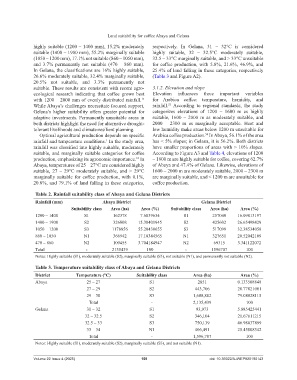
                 Table 2. Rainfall suitability class of Abaya and Gelana Districts
                 Rainfall (mm)                Abaya District                              Gelana District
                                Suitability class  Area (ha)   Area (%)     Suitability class  Area (ha)   Area (%)
                 1200 – 1400          S1           162378      7.6039634          S1           257040     16.09813197
                 1400 – 1900          S2           326808     15.30401945         S2           425602     26.65498429
                 1050 – 1200          S3          1178856     55.20438655         S3           517099     32.38534058
                 860 – 1050           N1           366942     17.18344565         N1           327651     20.52042109
                 470 – 860            N2           100455     3.704184947         N2           69315      3.341122072
                 Total                 -          2135439         100              -          1596707        100
                 Notes: Highly suitable (S1), moderately suitable (S2), marginally suitable (S3), not suitable (N1), and permanently not suitable (N2).
                 Table 3. Temperature suitability class of Abaya and Gelana Districts
                 District          Temperature (°C)          Suitability class        Area (ha)            Area (%)
                 Abaya                 25 – 27                     S1                   2851              0.133508848
                                       27 – 29                     S2                  443,706            20.77821001
                                       29 – 30                     S3                 1,688,882           79.08828115
                                        Total                       -                 2,135,439              100
                 Gelana                31 – 32                     S1                  93,973             5.885425441
                                      32 – 32.5                    S2                  346,104            21.67611215
                                      32.5 – 33                    S3                  750,139            46.98037899
                                       33 – 34                     N1                  406,491            25.45808342
                                        Total                       -                 1,596,707              100
                 Notes: Highly suitable (S1), moderately suitable (S2), marginally suitable (S3), and not suitable (N1).


                Volume 22 Issue 4 (2025)                       159                           doi: 10.36922/AJWEP025190143

