


Page 169 - AJWEP-22-4
P. 169
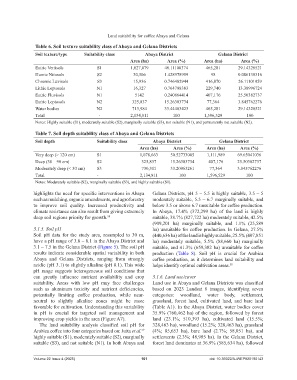
Land suitability for coffee Abaya and Gelana

                 Table 6. Soil texture suitability class of Abaya and Gelana Districts
                 Soil texture/type    Suitability class          Abaya District                  Gelana District
                                                          Area (ha)        Area (%)        Area (ha)       Area (%)
                 Eutric Vertisols           S1            1,027,079      48.11100374        465,281       29.14328521
                 Humic Nitosols             S2              30,506       1.428978959          98          0.006138316
                 Chromic Luvisols           S3              15,936       0.746482944        416,870       26.11101959
                 Lithic Leptosols           N1              16,327       0.764798383        229,740       13.38996724
                 Eutric Fluvisols           N1              5142         0.240864414        407,176       25.50382737
                 Eutric Leptosols           N2             325,837       15.26303734        77,364        3.845762276
                 Water bodies               N2             713,984       33.44483423        465,281       29.14328521
                 Total                       -            2,134,811          100           1,596,529          100
                 Notes: Highly suitable (S1), moderately suitable (S2), marginally suitable (S3), not suitable (N1), and permanently not suitable (N2).

                 Table 7. Soil depth suitability class of Abaya and Gelana Districts
                 Soil depth                 Suitability class       Abaya District                Gelana District
                                                               Area (ha)     Area (%)       Area (ha)      Area (%)
                 Very deep (> 120 cm)       S1                 1,078,663    50.52733005     1,111,989     69.65041036
                 Deep (30 – 90 cm)          S2                 325,837      15.26303734      407,176      25.50382737
                 Moderately deep (< 30 cm)  S3                 730,311      33.20963261      77,364       3.845762276
                 Total                      -                  2,134,811        100         1,596,529        100
                 Notes: Moderately suitable (S2), marginally suitable (S3), and highly suitable (S1).

                highlights the need for specific interventions in Abaya   Gelana Districts, pH 5 – 5.5 is highly suitable, 3.5 – 5
                such as mulching, organic amendments, and agroforestry   moderately suitable, 5.5 – 6.7 marginally suitable, and
                to improve  soil quality. Increased  productivity  and   below 3.5 or above 6.7 unsuitable for coffee production.
                climate resistance can also result from giving extremely   In  Abaya, 17.4% (372,299 ha) of the land is highly
                deep soil regions priority for growth. 58           suitable, 38.7% (827,722 ha) moderately suitable, 42.5%
                                                                    (909,201 ha) marginally suitable, and 1.1% (25,589
                3.1.5. Soil pH                                      ha) unsuitable for coffee production. In Gelana, 27.5%
                Soil  pH data  for the  study area,  resampled  to 30  m,   (440,636 ha) of the land is highly suitable, 25.5% (407,851
                have a pH range of 3.8 – 8.1 in the Abaya District and   ha) moderately suitable, 5.5% (88,660 ha) marginally
                3.1 – 7.5 in the Gelana District (Figure 5). The soil pH   suitable, and 41.3% (659,382 ha) unsuitable for coffee
                results indicate considerable spatial variability in both   production (Table  8). Soil pH is crucial for  Arabica
                Abaya  and  Gelana  Districts,  ranging  from  strongly   coffee production, as it determines land suitability and
                acidic (pH 3.1) to slightly alkaline (pH 8.1). This wide   helps identify optimal cultivation areas. 38
                pH range  suggests heterogeneous  soil conditions  that
                can  greatly  influence  nutrient  availability  and  crop   3.1.6. Land use/cover
                suitability.  Areas with  low pH may  face  challenges   Land use in Abaya and Gelana Districts was classified
                such  as  aluminum  toxicity  and  nutrient  deficiencies,   based  on  2023  Landsat  8  images,  identifying  seven
                potentially  limiting  coffee  production,  while  near-  categories:  woodland, water body, settlement,
                neutral  to slightly  alkaline zones might  be more   grassland, forest land, cultivated  land, and bare land
                favorable for cultivation. Understanding this variability   (Table A1). In the Abaya District, water bodies cover
                in pH is crucial  for targeted soil management  and   35.9% (760,462 ha) of the region, followed by forest
                improving crop yields in the area (Figure A7).      land (23.1%; 510,393 ha), cultivated  land (15.5%;
                  The  land  suitability  analysis  classified  soil  pH  for   328,463 ha), woodland (15.2%; 328,463 ha), grassland
                Arabica coffee into four categories based on: Juita et al.    (4%;  85,653 ha),  bare  land  (2.7%;  58,051 ha),  and
                                                               59
                highly suitable (S1), moderately suitable (S2), marginally   settlements (2.3%; 48,985 ha). In the Gelana District,
                suitable (S3), and not suitable (N1). In both Abaya and   forest land dominates at 36.9% (585,634 ha), followed


                Volume 22 Issue 4 (2025)                       161                           doi: 10.36922/AJWEP025190143

