


Page 173 - AJWEP-22-4
P. 173
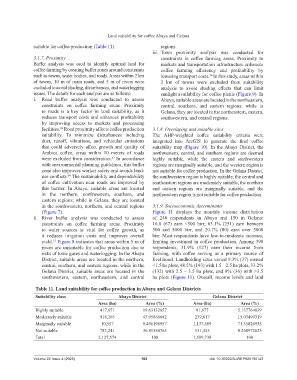
Land suitability for coffee Abaya and Gelana

                suitable for coffee production (Table 11).              regions.
                                                                    iii.  Town proximity  analysis was conducted  for
                3.1.7. Proximity                                        constraints  in  coffee  farming  areas.  Proximity  to
                Buffer  analysis  was  used  to  identify  optimal  land  for   markets and transportation infrastructure enhances
                coffee farming by creating buffer zones around constraints   coffee  farming  efficiency  and  profitability  by
                such as towns, water bodies, and roads. Areas within 2 km   lowering transport costs.  In this study, areas within
                                                                                             36
                of towns, 10 m of main roads, and 5 m of rivers were    2  km of towns were excluded from suitability
                excluded to avoid shading, disturbances, and waterlogging   analysis  to  avoid  shading  effects  that  can  limit
                issues. The details for each analysis are as follows:   sunlight availability for coffee plants (Figure 9). In
                i.  Road  buffer  analysis  was  conducted  to  assess   Abaya, suitable areas are located in the northeastern,
                   constraints  on  coffee  farming  areas.  Proximity   central,  southern, and eastern regions; while in
                   to roads is a key factor in land suitability, as it   Gelana, they are located in the northeastern, eastern,
                   reduces  transport  costs  and  enhances  profitability   southwestern, and central regions.
                   by improving access to markets and processing
                   facilities.  Road proximity affects coffee production   3.1.8. Overlaying and suitable sites
                            62
                   suitability.  To minimize  disturbances including   The  AHP-weighted  coffee  suitability  criteria  were
                   dust,  runoff,  vibrations,  and  vehicular  emissions   integrated  into  ArcGIS  to  generate  the  final  coffee
                   that  could  adversely  affect  growth  and  quality  of   suitability  map  (Figure  10).  In  the Abaya  District,  the
                   Arabica  coffee,  areas  within  10  meters  of  roads   northwestern, central, and southern regions are deemed
                   were excluded from consideration.  In accordance   highly suitable, while the eastern and southwestern
                                                  63
                   with environmental planning guidelines, this buffer   regions are marginally suitable, and the western region is
                   zone also improves worker safety and avoids land-  not suitable for coffee production. In the Gelana District,
                   use conflicts.  The sustainability and dependability   the southwestern region is highly suitable, the central and
                               64
                   of  coffee  cultivation  near  roads  are  improved  by   southeastern regions are moderately suitable, the northern
                   this barrier. In  Abaya, suitable areas are located   and eastern regions are marginally suitable, and the
                   in the  northern, northwestern,  southern, and   northwestern region is not suitable for coffee production.
                   eastern regions; while in Gelana, they are located
                   in the southwestern, northern, and central regions   3.1.9. Socioeconomic determinants
                   (Figure 7).                                      Figure  11 displays the  monthly  income  distribution
                ii.  River  buffer  analysis  was  conducted  to  assess   of  248  respondents  in  Abaya  and  150  in  Gelana:
                   constraints  on  coffee  farming  areas.  Proximity   16.8  (67) earn <500 birr, 63.1% (251) earn between
                   to  water  sources  is  vital  for  coffee  growth,  as   500 and 5000 birr, and 20.1% (80) earn over 5000
                   it  reduces  irrigation  costs and  improves  overall   birr. Most respondents have low-to-moderate incomes,
                   yield.  Figure 8 indicates that areas within 5 m of   limiting investment in coffee production. Among 398
                        12
                   rivers are unsuitable for coffee production due to   respondents, 31.9% (127) earn their income  from
                   risks of toxic gases and waterlogging. In the Abaya   farming,  with  coffee  serving  as  a  primary  source  of
                   District, suitable areas are located in the northern,   livelihood. Landholding sizes varied 9.3% (37) owned
                   central, southern, and eastern regions; while in the   <1.5 ha plots, 48.5% (193) with 1.5 – 2.5 ha plots, 33.2%
                   Gelana  District,  suitable areas  are  located  in  the   (132) with 2.5 – 3.5 ha plots, and 9% (36) with >3.5
                   southwestern, eastern, northeastern, and central   ha plots (Figure 11). Overall, income levels and land

                 Table 11. Land suitability for coffee production in Abaya and Gelana Districts
                 Suitability class                   Abaya District                            Gelana District
                                            Area (ha)            Area (%)             Area (ha)            Area (%)
                 Highly suitable             417,671            19.63132657            81,677             5.137764839
                 Moderately suitable         916,105            43.05866682            239,017            15.03499319
                 Marginally suitable          10,557            0.496198957           1,137,589           71.55826935
                 Not suitable                783,241            36.81380765            131,455            8.268972623
                 Total                      2,127,574               100               1,589,738              100


                Volume 22 Issue 4 (2025)                       165                           doi: 10.36922/AJWEP025190143

