


Page 168 - AJWEP-22-4
P. 168
Deresse, et al.

                  The  study  classified  slopes  for  coffee  production   coffee  production. According  to  Martinez  et al.,  the
                                                                                                                13
                using a previously  reported  framework: 0 – 5% as   significance  of  focused  interventions  for  sustainable
                                                     18
                highly  suitable  (S1), 5  –  10%  moderately  suitable   coffee  development  is  highlighted  by  the  restricted
                (S2), 10 – 20% marginally suitable (S3), 20 – 40% not   availability of optimal Humic Nitosols in both districts.
                suitable (N1), and > 40% permanently unsuitable (N2)
                for  coffee  cultivation  in  Abaya  and  Gelana  Districts   3.1.4. Soil depth
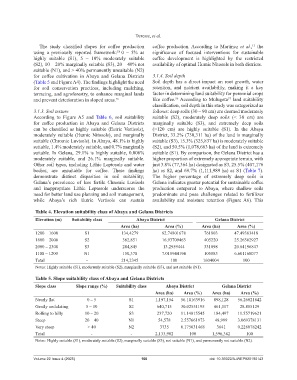
                (Table 5 and Figure A4). The findings highlight the need   Soil depth has a direct impact on root growth, water
                for soil  conservation  practices,  including  mulching,   retention,  and  nutrient  availability,  making  it  a  key
                terracing, and agroforestry, to enhance marginal lands   factor in determining land suitability for perennial crops
                                                                                                     57
                and prevent deterioration in sloped areas. 55       like coffee.  According to Mulugeta  land suitability
                                                                              56
                                                                    classification, soil depth in this study was categorized as
                3.1.3. Soil texture                                 follows: deep soils (30 – 90 cm) are deemed moderately
                According to  Figure A5  and  Table  6, soil suitability   suitable (S2), moderately  deep  soils  (<  30  cm)  are
                for  coffee  production  in  Abaya  and  Gelana  Districts   marginally  suitable (S3), and extremely  deep soils
                can  be  classified  as  highly  suitable  (Eutric Vertisols),   (>120  cm)  are  highly  suitable (S1). In the  Abaya
                moderately suitable (Humic Nitosols), and marginally   District, 33.2% (730,311 ha) of the land is marginally
                suitable (Chromic Luvisols). In Abaya, 48.1% is highly   suitable (S3), 15.3% (325,837 ha) is moderately suitable
                suitable, 1.4% moderately suitable, and 0.7% marginally   (S2), and 50.5% (1,078,663 ha) of the land is extremely
                suitable.  In  Gelana,  29.1%  is  highly  suitable, 0.006%   suitable (S1). By comparison, the Gelana District has a
                moderately suitable, and 26.1% marginally suitable.   higher proportion of extremely appropriate terrain, with
                Other soil types, including Lithic Leptosols and water   just 3.8% (77,364 ha) designated as S3, 25.5% (407,176
                bodies, are unsuitable  for  coffee.  These  findings   ha) as S2, and 69.7% (1,111,989 ha) as S1 (Table 7).
                demonstrate distinct disparities in soil suitability;   The  higher  percentage  of extremely  deep  soils in
                Gelana’s  prevalence  of  less  fertile  Chromic  Luvisols   Gelana indicates greater potential for sustainable coffee
                and  inappropriate  Lithic  Leptosols  underscores  the   production  compared  to  Abaya,  where  shallow  soils
                need for better land use planning and soil management,   predominate  and pose challenges  related  to fertilizer
                while  Abaya’s rich Eutric  Vertisols can sustain   availability  and  moisture  retention  (Figure A6).  This

                 Table 4. Elevation suitability class of Abaya and Gelana Districts
                 Elevation (m)   Suitability class           Abaya District                     Gelana District
                                                      Area (ha)           Area (%)        Area (ha)      Area (%)
                 1200 – 1600          S1              134,4279          62.74801678        761803       47.49383418
                 1600 – 2000          S2               362,851          16.93709463        405220       25.26302927
                 2000 – 2300          S3               284,845           13.2959444        331098       20.64196847
                 1100 – 1200          N1               150,370          7.018944194        105883       6.601168077
                 Total                 -              214,2345              100           1604004           100
                 Notes: Highly suitable (S1), moderately suitable (S2), marginally suitable (S3), and not suitable (N1).

                 Table 5. Slope suitability class of Abaya and Gelana Districts

                 Slope class      Slope range (%)   Suitability class     Abaya District           Gelana District
                                                                     Area (ha)    Area (%)    Area (ha)    Area (%)
                 Nearly flat           0 – 5              S1         1,197,154   56.10163916   898,128    56.26021842
                 Gently undulating     5 – 10             S2          640,715    30.02551195   461,117     28.885129
                 Rolling to hilly     10 – 20             S3          237,720    11.14015545   184,497    11.55719621
                 Steep                20 – 40             N1           54,578    2.557661973    48,999    3.069378131
                 Very steep             > 40              N2           3735      0.175031468    3641      0.228078242
                 Total                   -                 -         2,133,902      100       1,596,382      100
                 Notes: Highly suitable (S1), moderately suitable (S2), marginally suitable (S3), not suitable (N1), and permanently not suitable (N2).


                Volume 22 Issue 4 (2025)                       160                           doi: 10.36922/AJWEP025190143

