


Page 121 - AJWEP-22-5
P. 121
Land–cover change in the Ngerengere River

                               a                                      b


                                                                      c


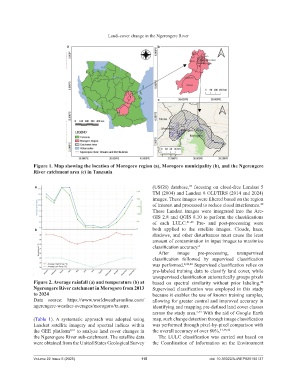
                Figure 1. Map showing the location of Morogoro region (a), Morogoro municipality (b), and the Ngerengere
                River catchment area (c) in Tanzania


                a                                                   (USGS)  database,  focusing on cloud-free Landsat 5
                                                                                    39
                                                                    TM (2004) and Landsat 8 OLI/TIRS (2014 and 2024)
                                                                    images. These images were filtered based on the region
                                                                    of interest and processed to reduce cloud interference.
                                                                                                                    40
                                                                    These Landsat images were integrated  into the  Arc-
                                                                    GIS 2.8 and QGIS 8.10 to perform the classifications
                                                                    of each LULC.  41-43  Pre-  and post-processing were
                b                                                   both  applied  to  the  satellite  images.  Clouds, haze,
                                                                    shadows, and other disturbances must cause the least
                                                                    amount of contamination in input images to maximize
                                                                    classification accuracy. 2
                                                                       After   image    pre-processing,  unsupervised
                                                                    classification  followed  by  supervised  classification
                                                                    was performed. 2,42,44  Supervised classification relies on
                                                                    pre-labeled training data to classify land cover, while
                                                                    unsupervised classification automatically groups pixels
                Figure 2. Average rainfall (a) and temperature (b) at   based on spectral  similarity  without prior labeling.
                                                                                                                    42
                Ngerengere River catchment in Morogoro from 2013    Supervised  classification  was  employed  in  this  study
                to 2024                                             because it enables the use of known training samples,
                Data  source:  https://www.worldweatheronline.com/  allowing for greater control and improved accuracy in
                ngerengere-weather-averages/morogoro/tz.aspx        identifying and mapping pre-defined land cover classes
                                                                    across the study area. 2,44  With the aid of Google Earth
                (Table  1). A  systematic  approach  was adopted  using   map, such change detection through image classification
                Landsat satellite imagery and spectral indices within   was performed through pixel-by-pixel comparison with
                the GEE platform 9,31  to analyze land cover changes in   the overall accuracy of over 80%. 41,45,46
                the Ngerengere River sub-catchment. The satellite data   The LULC classification was carried out based on
                were obtained from the United States Geological Survey   the  Coordination  of Information  on the  Environment


                Volume 22 Issue 5 (2025)                       115                           doi: 10.36922/AJWEP025180137

