


Page 124 - AJWEP-22-5
P. 124
Nkinda, et al.

                                    ( Current LULC area −           transformations  in  landscape  composition,  primarily
                                                                    driven by anthropogenic  activities,  as illustrated  in
                Percentage change =  Previous LULC area)    (VII)   Table  4.  The results showed a marked decline  in
                                   ( Previouus LULC area)
                                                                    vegetated areas over the two decades, accompanied by
                                                                    a  significant  increase  in  bare  land  and  built–up  areas
                2.2.4. Human activities performed along the         (Table 4).
                Ngerengere River catchment                             In 2004, sparse vegetation  was the  dominant  land
                Between  March  and  April  2025,  systematic  field   cover type in the Ngerengere River catchment, covering
                surveys were conducted along ten 150-m transects to   50.92% (1416 km ) of the total area. This was followed
                                                                                    2
                assess anthropogenic activities contributing to LULCCs   by bare land, which accounted for 30.56% (850 km ), and
                                                                                                                2
                within the Ngerengere River sub-catchment. Observed   shrubland at 11.21% (312 km ) (Table 4 and Figure 3).
                                                                                              2
                activities were geolocated using GPS devices to enable   Grassland made up 5.57% of the total area (155 km ),
                                                                                                                   2
                accurate  spatial  mapping  and analysis.  In addition,   while  built–up  areas  were  minimal,  covering  only
                spectral indices – including the Normalized Difference   0.67% (19 km ). Dense vegetation and wetlands were
                                                                                 2
                Vegetation Index, NDBI, and MNDWI – were applied    extremely limited, occupying just 0.04% (1 km ) and
                                                                                                                2
                to satellite imagery to detect and monitor spatial patterns   0.04% (1 km ), respectively  (Table  4 and  Figure  3).
                                                                                2
                of environmental change, such as deforestation, urban   Water  bodies  covered  0.98% (27 km ) of the  area.
                                                                                                       2
                expansion, and water body shrinkage. These approaches   The predominance of sparse vegetation  and bare
                allowed for the integration of field-based observations   land indicates  that  the river catchment  was largely
                with  remotely  sensed  data  to  evaluate  the  extent  and   characterized  by  semi–arid  conditions  with  limited
                impact of anthropogenic activities within the catchment.  forest cover (Figure 3).
                                                                       By 2014, the Ngerengere River catchment experienced
                3. Results                                          marked LULCCs, reflecting intensified human activity
                                                                    and environmental  pressures (Table  4 and  Figure  4).
                3.1. Classification accuracy assessments            Bare  land  expanded  significantly  to  44.42%  of  the
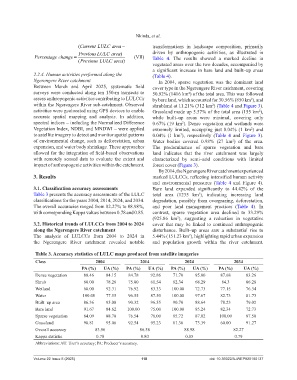
                Table 3 presents the accuracy assessments of the LULC   total  area  (1235 km ), indicating  increasing  land
                                                                                         2
                classifications for the years 2004, 2014, 2024, and 2034.   degradation, possibly from overgrazing, deforestation,
                The overall accuracies ranged from 82.27% to 88.98%,   and poor land management  practices  (Table  4). In
                with corresponding Kappa values between 0.78 and 0.85.  contrast,  sparse vegetation  area  declined  to 33.29%
                                                                    (925.86 km ), suggesting a reduction  in vegetative
                                                                               2
                3.2. Historical trends of LULCCs from 2004 to 2024   cover that may be linked to continued anthropogenic
                along the Ngerengere River catchment                disturbance.  Built–up  areas  saw  a  substantial  rise  to
                The analysis of LULCCs from 2004 to 2024 in         5.44% (151.23 km ), highlighting rapid urban expansion
                                                                                    2
                the Ngerengere River catchment revealed  notable    and population  growth within  the  river  catchment.

                 Table 3. Accuracy statistics of LULC maps produced from satellite imageries
                 Class                     2004                2014               2024                  2034
                                     PA (%)    UA (%)    PA (%)   UA (%)    PA (%)    UA (%)     PA (%)     UA (%)
                 Dense vegetation     88.46     84.15     84.78    92.86     71.70     95.00      87.68      83.26
                 Shrub                60.00     78.26     75.00    61.54     82.34     68.29       84.3      86.28
                 Wetland              60.00     92.31     76.92    83.33     100.00    72.73      77.15      76.34
                 Water               100.00     77.55     96.55    87.50     100.00    97.67      82.73      81.73
                 Built–up area        86.36     95.00     90.32    96.55     90.70     88.64      78.23      79.02
                 Bare land            91.67     84.62    100.00    75.00     100.00    95.24      82.34      72.73
                 Sparse vegetation    84.09     88.70     76.54    78.00     85.72     87.02      100.00     87.50
                 Grassland            90.81     95.06     92.54    95.23     81.36     73.39      60.00      91.27
                 Overall accuracy          83.96               86.58              88.98                 82.27
                 Kappa statistic           0.78                0.80                0.85                 0.79
                 Abbreviations: AU: User’s accuracy; PA: Producer’s accuracy.


                Volume 22 Issue 5 (2025)                       118                           doi: 10.36922/AJWEP025180137

