


Page 123 - AJWEP-22-5
P. 123
Land–cover change in the Ngerengere River
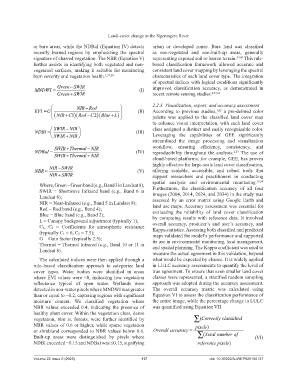
or bare areas, while the NDBaI (Equation IV) detects urban or developed zones. Bare land was classified
recently burned regions by emphasizing the spectral as non-vegetated and non-built-up areas, generally
signature of charred vegetation. The NBR (Equation V) representing exposed soil or barren terrain. 59,60 This rule-
further assists in identifying both vegetated and non- based classification framework allowed accurate and
vegetated surfaces, making it suitable for monitoring consistent land cover mapping by leveraging the spectral
burn severity and vegetation health. 1,57,58 characteristics of each land cover type. The integration
of spectral indices with logical conditions significantly
Green SWIR�� improved classification accuracy, as demonstrated in
MNDWI (I)
Green SWIR�� recent remote sensing studies. 2,33,61
NIRRed 2.2.3. Visualization, export, and accuracy assessment
−
=
EVI G (II) According to previous studies, 1,62 a pre-defined color
( NIRC )( RedC )( Blue L)
+
+ 1 − 2 palette was applied to the classified land cover map
to enhance visual interpretation, with each land cover
SWIR NIR�� class assigned a distinct and easily recognizable color.
NDBI�� (III)
SWIR NIR�� Leveraging the capabilities of GEE significantly
streamlined the image processing and visualization
SWIR ThermalNIR�� �� workflow, ensuring efficiency, consistency, and
NDBaI � (IV) reproducibility throughout the analysis. 2,57 The use of
SWIR ThermalNIR�� ��
cloud-based platforms, for example, GEE, has proven
highly effective for large-scale land cover classification,
NIRSWIR��
NBR� (V) offering scalable, accessible, and robust tools that
NIRSWIR�� support researchers and practitioners in conducting
Where, Green = Green band (e.g., Band 3 in Landsat 8); spatial analysis and environmental monitoring. 16,54
SWIR = Shortwave Infrared band (e.g., Band 6 in Furthermore, the classification accuracy of all four
Landsat 8); images (2004, 2014, 2024, and 2034) in the study was
NIR = Near-Infrared (e.g., Band 5 in Landsat 8); assessed by an error matrix using Google Earth and
land use maps. Accuracy assessment was essential for
Red = Red band (e.g., Band 4); evaluating the reliability of land cover classification
Blue = Blue band (e.g., Band 2); by comparing results with reference data. It involved
L = Canopy background adjustment (typically 1); overall accuracy, producer’s and user’s accuracy, and
C₁, C₂ = Coefficients for atmospheric resistance Kappa statistics. Assessing both classified and predicted
(typically C₁ = 6, C₂ = 7.5); maps validated the model’s performance and supported
G = Gain factor (typically 2.5); its use in environmental monitoring, land management,
Thermal = Thermal Infrared (e.g., Band 10 or 11 in and spatial planning. The Kappa coefficient was used to
Landsat 8).
measure the actual agreement in this validation, beyond
The calculated indices were then applied through a what would be expected by chance. It is widely applied
rule–based classification approach to categorize land in LULC accuracy assessments to quantify the level of
cover types. Water bodies were identified in areas true agreement. To ensure that even smaller land cover
where EVI values were <0, indicating low vegetation classes were represented, a stratified random sampling
reflectance typical of open water. Wetlands were approach was adopted during the accuracy assessment.
detected in non-water pixels where MNDWI was greater The overall accuracy metric was calculated using
than or equal to −0.2, capturing regions with significant Equation VI to assess the classification performance of
moisture content. We classified vegetation where the entire image, while the percentage change in LULC
NBR values exceeded 0.4, indicating the presence of was quantified using Equation VII.
healthy plant cover. Within the vegetation class, dense
vegetation, that is, forests, were further identified by ∑ ( Correctly classidied
NBR values of 0.6 or higher, while sparse vegetation pixels)
or shrubland corresponded to NBR values below 0.6. Overallaccuracy =
Built-up areas were distinguished by pixels where ∑ ( Total numberoff (VI)
NDBI exceeded −0.15 and NDBaI was ≤0.15, signifying referencepixels)
Volume 22 Issue 5 (2025) 117 doi: 10.36922/AJWEP025180137

