


Page 125 - AJWEP-22-5
P. 125
Land–cover change in the Ngerengere River

                 Table 4. LULCC (in km ) between 2000 and 2034 along the Ngerengere River sub–catchment
                                       2
                 Land cover              2004                 2014                  2024                  2034
                                     km 2      %         km 2        %         km 2        %         km 2        %
                 Dense vegetation    1.0      0.04       10.01      0.36      198.09      7.13      92.57       3.33
                 Grass land          155      5.57      204.34      7.36      145.95      5.25      141.1       5.08
                 Wetland             1.0      0.04       2.50       0.09      13.62       0.49       3.06       0.11
                 Water               27       0.98       1.95       0.07       1.95       0.07      12.23       0.44
                 Built–up area       19       0.67      151.23      5.44      58.38       2.1        25.3       0.91
                 Bare land           850      30.56     1235.08     44.42    1098.89     39.14      856.07     30.81
                 Sparse vegetation  1416      50.92     925.86      33.29     174.22      6.28     1449.19     52.13
                 Shrubland           312      11.21      249        8.97     1098.41     39.54      199.38      7.19
                 Total              2780      100        2780       100        2780       100        2780       100
                 Abbreviation: LULCC: Land use and land cover change.


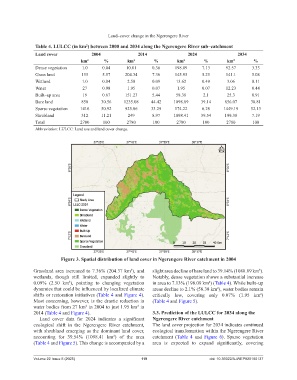
                            Figure 3. Spatial distribution of land cover in Ngerengere River catchment in 2004

                Grassland area increased to 7.36% (204.37 km ), and   slight area decline of bare land to 39.14% (1088.89 km ).
                                                                                                                   2
                                                           2
                wetlands,  though  still  limited,  expanded  slightly  to   Notably, dense vegetation shows a substantial increase
                0.09% (2.50 km ), pointing to changing vegetation   in area to 7.13% (198.09 km ) (Table 4). While built–up
                               2
                                                                                             2
                dynamics that could be influenced by localized climate   areas decline to 2.1% (58.38 km ), water bodies remain
                                                                                                 2
                shifts or restoration initiatives (Table 4 and Figure 4).   critically  low, covering  only 0.07% (1.95 km )
                                                                                                                    2
                Most concerning, however, is the drastic reduction in   (Table 4 and Figure 5).
                water bodies from 27 km  in 2004 to just 1.95 km  in
                                                             2
                                       2
                2014 (Table 4 and Figure 4).                        3.3. Prediction of the LULCC for 2034 along the
                  Land  cover  data  for  2024  indicates  a  significant   Ngerengere River catchment
                ecological  shift in the  Ngerengere  River  catchment,   The land cover projection for 2034 indicates continued
                with shrubland emerging as the dominant land cover,   ecological transformation within the Ngerengere River
                accounting  for 39.54% (1098.41 km ) of the  area   catchment  (Table  4 and  Figure  6). Sparse vegetation
                                                   2
                (Table 4 and Figure 5). This change is accompanied by a   area  is  expected  to  expand  significantly,  covering


                Volume 22 Issue 5 (2025)                       119                           doi: 10.36922/AJWEP025180137

