


Page 122 - AJWEP-22-5
P. 122
Nkinda, et al.

                 Table 1. Satellite images used for LULC change analysis and their characteristics
                 No.  Data type          Source  Resolution (m)  Bands    Path/Row     Cloud cover (%)      Date
                 1    Landsat 5 TM (2004)  USGS        30       1,2,3,4  148 – 49/36 – 37    10        March 28, 2004
                 2    Landsat 8 OLI      USGS          30       2,3,4,5  148 – 49/36 – 37    10         June 17, 2014
                 3    Landsat 8 TIRS     USGS          30       1,2,3,4                      10         April 26, 2024
                 Abbreviations: LULC: Land use and land cover; USGS: United States Geological Survey.
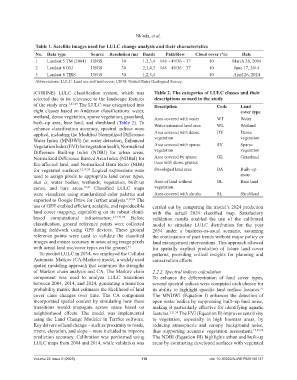
                (CORINE)  LULC  classification  system,  which  was   Table 2. The categories of LULC classes and their
                selected due to its relevance to the landscape features   descriptions as used in the study
                of the study area. 7,47-49  The LULC was categorized into   Description          Code      Land
                eight classes based on Anderson classifications: water,                                    cover type
                wetland, dense vegetation, sparse vegetation, grassland,   Area covered with water  WT     Water
                built–up area, bare land, and shrubland (Table 2). To
                enhance  classification  accuracy,  spectral  indices  were   Water-saturated land area  WL  Wetland
                applied, including the Modified Normalized Difference   Area covered with dense   DV       Dense
                Water Index (MNDWI) for water detection, Enhanced    vegetation                            vegetation
                Vegetation Index (EVI) for vegetation health, Normalized   Area covered with sparse   SV   Sparse
                Difference  Built-up  Index  (NDBI)  for  urban  areas,   vegetation                       vegetation
                Normalized Difference Burned Area Index (NDBaI) for   Area covered by sparse     GL        Grassland
                fire-affected land, and Normalized Burn Ratio (NBR)   trees with dense grasses
                for vegetated surfaces. 12,19,50  Logical expressions were   Developed land area  BA       Built–up
                used to assign pixels to appropriate land cover types,                                     areas
                that is, water bodies, wetlands, vegetation,  built-up   Area of land without    BL        Bare land
                zones,  and  bare  areas. 18,31   Classified  LULC  maps   vegetation
                were visualized using standardized color palettes and   Area covered with shrubs  SL       Shrubland
                exported to Google Drive for further analysis. 6,12,24  The
                use of GEE enabled efficient, scalable, and reproducible   carried out by comparing the model’s 2024 prediction
                land cover mapping, capitalizing on its robust cloud-  with  the  actual  2024  classified  map.  Satisfactory
                based computational  infrastructure. 2,15,51,52  Before   validation  results enabled  the use of the calibrated
                classification,  ground  reference  points  were  collected   model to simulate  LULC distribution for the year
                during  fieldwork  using  GPS  devices.  These  ground   2034 under a business-as-usual scenario, assuming
                reference  points  were  used  to  validate  the  classified   the continuation of past trends without major policy or
                images and ensure accuracy in associating image pixels   land management interventions. This approach allowed
                with actual land use/cover types on the ground. 53  for  spatially  explicit  prediction  of  future  land  cover
                  To predict LULC in 2034, we employed the Cellular   patterns, providing critical  insights for planning and
                Automata–Markov (CA-Markov) model, a widely used    conservation efforts.
                spatial modeling approach that combines the strengths
                of Markov chain analysis and CA. The Markov chain   2.2.2. Spectral indices calculation
                component  was used to analyze  LULC transitions    To  enhance  the  differentiation  of  land  cover  types,
                between 2004, 2014, and 2024, generating a transition   several spectral indices were computed each chosen for
                probability matrix that estimates the likelihood of land   its ability to highlight specific land surface features.
                                                                                                                    51
                cover class changes over time.  The CA component    The MNDWI (Equation I) enhances the detection  of
                incorporated  spatial  context  by  simulating  how  these   open water bodies by suppressing built–up land noise,
                transitions would propagate across space based on   making it particularly effective for identifying aquatic
                neighborhood  effects.  The  model  was  implemented   features. 2,11,54  The EVI (Equation II) improves sensitivity
                using the  Land Change  Modeler  in TerrSet software.   to vegetation,  especially  in high biomass areas, by
                Key drivers of land change – such as proximity to roads,   reducing atmospheric and canopy background noise,
                rivers, elevation, and slope – were included to improve   thus supporting accurate  vegetation  assessment. 17,55,56
                prediction accuracy. Calibration was performed using   The NDBI (Equation III) highlights urban and built-up
                LULC maps from 2004 and 2014, while validation was   areas by contrasting developed surfaces with vegetated


                Volume 22 Issue 5 (2025)                       116                           doi: 10.36922/AJWEP025180137

