


Page 127 - AJWEP-22-5
P. 127
Land–cover change in the Ngerengere River


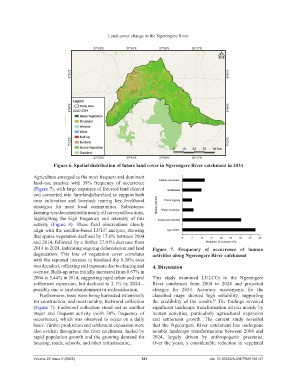
                         Figure 6. Spatial distribution of future land cover in Ngerengere River catchment in 2034


                Agriculture emerged as the most frequent and dominant
                land–use  practice  with  38%  frequency  of  occurrence
                (Figure 7), with large expanses of forested land cleared
                and converted into farmlands/bareland to support both
                crop cultivation and livestock rearing key livelihood
                strategies for  most  local  communities.  Subsistence
                farming was documented in nearly all surveyed locations,
                highlighting the high frequency and intensity of this
                activity (Figure 8).  These  field  observations  closely
                align with the satellite-based LULC analysis, showing
                that sparse vegetation declined by 17.6% between 2004
                and 2014, followed by a further 27.01% decrease from
                2014 to 2024, indicating ongoing deforestation and land   Figure  7.  Frequency  of  occurrence  of human
                degradation.  This loss of vegetation cover correlates   activities along Ngerengere River catchment
                with the reported increase in bareland (by 8.58% over
                two decades), reflecting soil exposure due to clearing and   4. Discussion
                overuse. Built-up areas initially increased from 0.67% in
                2004 to 5.44% in 2014, suggesting rapid urban and rural   This  study  examined  LULCCs  in  the  Ngerengere
                settlement expansion, but declined to 2.1% by 2024 –   River  catchment from 2004 to 2024 and projected
                possibly due to land abandonment or reclassification.  changes for 2034.  Accuracy assessments for the
                  Furthermore, trees were being harvested extensively   classified  maps  showed  high  reliability,  supporting
                for construction, and most notably, fuelwood collection   the credibility of the results.   The  findings  revealed
                                                                                               39
                (Figure  7). Fuelwood collection  stood out as another   significant landscape transformation driven mainly by
                major  and frequent  activity  (with 30% frequency  of   human  activities,  particularly  agricultural  expansion
                occurrence), which was observed to occur on a daily   and settlement  growth.  The current study revealed
                basis. Timber production and settlement expansion were   that  the  Ngerengere  River  catchment  has undergone
                also evident throughout the river catchment, fueled by   notable landscape  transformations  between  2004 and
                rapid population growth and the growing demand for   2024, largely driven by anthropogenic  pressures.
                housing, roads, schools, and other infrastructure.  Over the years, a considerable reduction in vegetated


                Volume 22 Issue 5 (2025)                       121                           doi: 10.36922/AJWEP025180137

