


Page 193 - AJWEP-22-6
P. 193
Municipal street lighting retrofit in Bulgaria

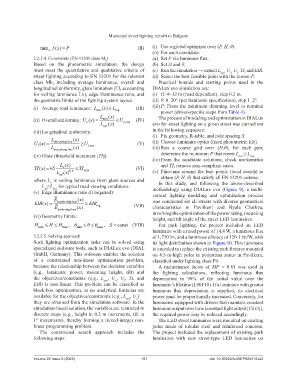
                   min fx =   P                               (II)  (i)  Use a global optimizer over (P, H, θ).
                         ( )
                      x
                                                                    (ii)  For each candidate:
                2.2.2.4. Constraints (EN 13201 class M )            (a)  Set P via luminous flux.
                                               k
                Based on the photometric  simulation,  the design   (b)  Set H and θ.
                must meet the quantitative  and qualitative  criteria  of   (c)  Run the simulation → extract L , U , U, TI, and EIR.
                                                                                                         l
                                                                                                      o
                                                                                                  ave
                street lighting according to EN 13201 for the relevant   (d)  Select the best feasible point with the lowest P.
                class  Mk, including average  luminance,  overall and   Practical  bounds  and starting points used in the
                longitudinal uniformity, glare limitation (TI, accounting   DIALux evo simulation are:
                for veiling luminance Lv), edge illuminance ratio, and   (i)  H: 4–12 m (road dependent), step 0.2 m.
                the geometric limits of the lighting system layout.  (ii)  θ: 0–20° (per luminaire specification), step 1–2°.
                                               x
                (i)  Average road luminance:  L () ≥ L req   (III)  (iii) P: From the minimum dimming level to nominal
                                            ave
                                                                        power (driver-specific steps from Table 4).
                                             L    x ()                 The process of modeling and optimization in DIALux
                (ii)  Overall uniformity: Ux()   min   U o,req    (IV)
                                       o
                                                 x
                                             L ()                   evo for street lighting on a given street was carried out
                                              ave
                (iii) Longitudinal uniformity:                      in the following sequence:
                                                                    (i)  Fix geometry, R-table, and pole spacing S.
                        L         x ()
                Ux()    min,along line   U                  (V)   (ii)  Choose luminaire optics (fixed photometric file).
                  l
                        L         x ()  l,req                       (iii) Run a coarse grid over (H,θ); for each pair,
                         max,along line
                (iv) Glare (threshold increment [TI]):                  determine the minimum P that meets L ≥ L .
                                                                                                          ave
                                                                                                               req
                                                                    (iv) From the  candidate  solutions,  check  uniformities
                           Lx ()                                        and TI; remove non-compliant cases.
                             v
                TI x()  65        TI max                   (VI)
                              x
                          L ()  . 08                                (v)  Fine-tune around the best points (local search) to
                           ad
                where L  is veiling luminance from glare sources and    obtain (P, H, θ) that satisfy all EN 13201 criteria.
                       v
                   L ≈L  for typical road viewing conditions.          In this study, and following the above-described
                     ad
                        ave
                (v)  Edge illuminance ratio (if required):          methodology  using DIALux evo  (Figure  9), a  multi-
                                                                    variant  lighting  modeling  and  optimization  process
                         E         ()x
                EIR () x =  outside edge lane  ≥  EIR               was conducted for all streets with diverse geometrical
                         E inside edge lane () x  req       (VII)   characteristics  in  Pavlikeni  and  Byala  Cherkva,
                (vi) Geometric limits:                              involving the optimization of the power rating, mounting
                                                                    height, and tilt angle of the street LED luminaires.
                H     H   H  ,          ,  S  const   (VIII)   For  park  lighting,  the  project  included  an  LED
                  min        max   min      max
                                                                    luminaire with a rated power of 14.4 W, a luminous flux
                2.2.2.5. Solving approach                           of 1,730 lm, and a luminous efficacy of 120.1 lm/W, with
                Such lighting  optimization  tasks can  be  solved  using   its light distribution shown in Figure 10. This luminaire
                specialized software tools, such as DIALux evo (DIAL   is intended to replace the existing park fixtures mounted
                GmbH, Germany). This software enables the solution   on 4.5-m-high poles in pedestrian zones in Pavlikeni,
                of a  constrained  non-linear  optimization  problem,   classified under lighting class P6.
                because the relationship between the decision variables   A maintenance factor of  MF = 0.81 was used in
                (e.g.,  luminaire  power, mounting  height,  tilt)  and   the  lighting  calculations,  reflecting  luminous  flux
                the  objectives/constraints  (e.g.,  L , U , U , TI, and   depreciation to 90% of the initial value over the
                                               ave
                                                        l
                                                    o
                EIR)  is  non-linear. This  problem  can  be  classified  as   luminaire’s lifetime (L90F10). If a luminaire with greater
                black-box optimization, as no analytical formulas are   luminous  flux  depreciation  is  supplied,  its  electrical
                available for the objectives/constraints (e.g., L , U )—  power must be proportionally increased. Conversely, for
                                                             o
                                                         ave
                they are obtained from the simulation software. In the   luminaires equipped with drivers that maintain constant
                simulation-based solution, the variables are restricted to   luminous output over time (constant light output [CLO]),
                discrete steps (e.g., height in 0.2 m increments, tilt in   the required power may be reduced accordingly.
                1° increments), thereby forming a mixed-integer non-   The LED street luminaires were mounted on existing
                linear programming problem.                         poles made of tubular steel and reinforced concrete.
                  The  constrained  search  approach  includes  the   The project included the replacement of existing park
                following steps:                                    luminaires  with new street-type  LED luminaires  on


                Volume 22 Issue 6 (2025)                       187                           doi: 10.36922/AJWEP025310242

