


Page 195 - AJWEP-22-6
P. 195
Municipal street lighting retrofit in Bulgaria


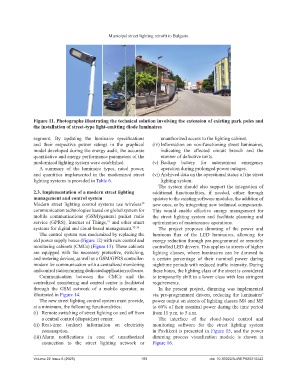
                Figure 11. Photographs illustrating the technical solution involving the extension of existing park poles and
                the installation of street-type light-emitting diode luminaires

                segment.  By  updating  the  luminaire  specifications   unauthorized access to the lighting cabinet.
                and their respective  power ratings in the  graphical   (iv) Information  on  non-functioning  street  luminaires,
                model developed during the energy audit, the accurate   indicating  the  affected  circuit  branch  and  the
                quantitative and energy performance parameters of the   number of defective units.
                modernized lighting system were established.        (v)  Backup battery for autonomous emergency
                  A summary  of the  luminaire  types, rated  power,    operation during prolonged power outages.
                and  quantities  implemented  in  the  modernized  street   (vi) Archived data on the operational status of the street
                lighting systems is provided in Table 6.                lighting system.
                                                                       The system should also support the integration  of
                2.3. Implementation of a modern street lighting     additional  functionalities,  if needed, either through
                management and control system                       updates to the existing software modules, the addition of
                Modern street  lighting  control  systems use wireless 30   new ones, or by integrating new technical components.
                communication technologies based on global system for   This  would  enable  effective  energy  management  for
                mobile  communications  (GSM)/general  packet  radio   the street  lighting  system and facilitate  planning  and
                service (GPRS), Internet of Things,  and other smart   optimization of maintenance operations.
                                                31
                systems for digital and cloud-based management. 32-34  The  project  proposes  dimming  of  the  power  and
                  The control system was modernized by replacing the   luminous  flux  of  the  LED  luminaires,  allowing  for
                old power supply boxes (Figure 12) with new control and   energy reduction through pre-programmed or remotely
                monitoring cabinets (CMCs) (Figure 13). These cabinets   controlled LED drivers. This applies to streets of higher
                are equipped with the necessary protective, switching,   lighting  classes, where luminaires  can be dimmed  to
                and metering devices, as well as a GSM/GPRS controller-  a certain percentage  of their nominal  power during
                modem for communication with a centralized monitoring   nighttime periods with reduced traffic intensity. During
                and control station running dedicated application software.  these hours, the lighting class of the street is considered
                  Communication  between  the  CMCs and the         to temporarily shift to a lower class with less stringent
                centralized monitoring and control center is facilitated   requirements.
                through  the  GSM network  of a  mobile  operator, as   In  the  present  project,  dimming  was  implemented
                illustrated in Figure 14.                           via  pre-programmed  drivers,  reducing  the  luminaires’
                  The new street lighting control system must provide,   power output on streets of lighting classes M4 and M5
                at a minimum, the following functionalities:        to 60% of their nominal power during the time period
                (i)  Remote switching of street lighting on and off from   from 11 p.m. to 5 a.m.
                   a central control (dispatcher) center.              The  interface of the  cloud-based  control  and
                (ii)  Real-time  (online)  information  on electricity   monitoring software for the street lighting system
                   consumption.                                     in Pavlikeni is presented in Figure 15, and the power
                (iii) Alarm  notifications  in  case  of  unauthorized   dimming  process visualization  module  is shown in
                   connection  to  the  street  lighting  network  or   Figure 16.


                Volume 22 Issue 6 (2025)                       189                           doi: 10.36922/AJWEP025310242

