


Page 12 - AN-4-4
P. 12
Advanced Neurology                                                     Epilepsy after traumatic brain injuries


            include repetition of actions, where individuals may engage   quality of life.  The multifaceted nature of TBI underscores
                                                                          48
            in the same behavior or task multiple times without realizing   the profound impact it has on individuals, affecting not only
            it. This repetitive behavior can hinder their ability to complete   their physical  health but also their  cognitive abilities and
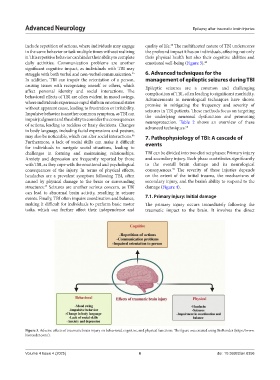
            daily activities. Communication problems are another   emotional well-being (Figure 3). 49
            significant cognitive impact, as individuals with TBI may
            struggle with both verbal and non-verbal communication.    6. Advanced techniques for the
                                                         45
            In addition, TBI can impair the orientation of a person,   management of epileptic seizures during TBI
            causing issues with recognizing oneself or others, which   Epileptic seizures are a common and challenging
            affect personal identity and social interactions. The   complication of TBI, often leading to significant morbidity.
            behavioral effects of TBI are often evident in mood swings,   Advancements in neurological techniques have shown
            where individuals experience rapid shifts in emotional states   promise in mitigating the frequency and severity of
            without apparent cause, leading to frustration or irritability.   seizures in TBI patients. These methods focus on targeting
            Impulsive behavior is another common symptom, as TBI can   the  underlying  neuronal  dysfunction  and  promoting
            impair judgment and the ability to consider the consequences   neuroprotection.  Table 2  shows an overview of these
            of actions, leading to reckless or hasty decisions. Changes   advanced techniques. 50
            in body language, including facial expressions and posture,
            may also be noticeable, which can alter social interactions.    7. Pathophysiology of TBI: A cascade of
                                                         46
            Furthermore,  a  lack  of  social  skills  can  make  it  difficult   events
            for individuals to navigate social situations, leading to
            challenges in forming and maintaining relationships.   TBI can be divided into two distinct phases: Primary injury
            Anxiety and depression are frequently reported by those   and secondary injury. Each phase contributes significantly
            with TBI, as they cope with the emotional and psychological   to the overall brain damage and its  neurological
                                                                          59
            consequences of the injury.  In terms  of  physical effects,   consequences.  The severity of these injuries depends
            headaches are a prevalent symptom following TBI, often   on the extent of the initial trauma, the mechanisms of
            caused by physical damage to the brain or surrounding   secondary injury, and the brain’s ability to respond to the
            structures.  Seizures are another serious concern, as TBI   damage (Figure 4).
                    47
            can lead to abnormal brain activity, resulting in seizure
            events. Finally, TBI often impairs coordination and balance,   7.1. Primary injury: Initial damage
            making it difficult for individuals to perform basic motor   The  primary injury occurs immediately  following  the
            tasks,  which  can  further  affect  their  independence  and   traumatic impact to the brain. It involves the direct


            Figure 3. Adverse effects of traumatic brain injury on behavioral, cognitive, and physical functions. The figure was created using BioRender (https://www.
            biorender.com/).


            Volume 4 Issue 4 (2025)                         6                                doi: 10.36922/an.8356

