


Page 60 - ARNM-2-3
P. 60
Advances in Radiotherapy
            & Nuclear Medicine                                                             NCRT for T3N0M0 ESCC


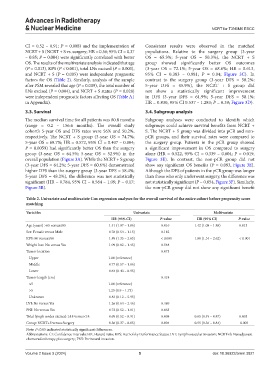
            CI =  0.52 – 0.91;  P =  0.008)  and  the implementation of   Consistent results were observed in the matched
            NCRT + S (NCRT + S vs. surgery; HR = 0.56; 95% CI = 0.37   populations. Relative to the surgery group (3-year
            – 0.85; P = 0.004) were significantly correlated with better   OS  =  65.3%; 5-year OS = 50.3%), the NCRT + S
            OS. The results of the multivariate analysis indicated that age   group showed significantly better OS outcomes
            (P = 0.013), KPS (P < 0.001), total LNs excised (P = 0.003),   (3-year OS  =  72.1%; 5-year OS = 68.6%; HR = 0.613,
            and NCRT + S (P = 0.005) were independent prognostic   95% CI =  0.383 – 0.981;  P  =  0.04;  Figure  3C). In
            factors for OS (Table 2). Similarly, analysis of the sample   contrast to the surgery group (3-year DFS = 58.2%;
            after PSM revealed that age (P = 0.009), the total number of   5-year DFS = 45.9%), the NCRT + S group did
            LNs excised (P = 0.004), and NCRT + S status (P = 0.028)   not show a statistically significant improvement
            were independent prognostic factors affecting OS (Table A1   in DFS (3-year DFS = 61.9%; 5-year DFS = 58.1%;
            in Appendix).                                      HR = 0.830, 95% CI 0.537 – 1.283; P = 0.39; Figure 3D).

            3.3. Survival                                      3.4. Subgroup analysis
            The median survival time for all patients was 80.8 months   Subgroup analyses were conducted to identify which
            (range = 0.2 – 156.6  months). The overall study   subgroups could achieve survival benefits from NCRT +
            cohort’s  5-year OS and DFS rates were  56% and 50.2%,   S. The NCRT + S group was divided into pCR and non-
            respectively. The NCRT + S group (3-year OS = 74.7%;   pCR  groups,  and  their  survival  rates  were  compared to
            5-year OS = 69.7%; HR = 0.572, 95% CI = 0.407 – 0.804;   the  surgery  group.  Patients  in  the  pCR  group  showed
            P = 0.0059) had significantly better OS than the surgery   a significant improvement in OS compared to surgery
            group (3-year OS = 64.5%; 5-year OS = 52.9%) in the   alone (HR = 0.522, 95% CI = 0.339 – 0.804; P  = 0.019,
            overall population (Figure 3A). While the NCRT + S group   Figure  3E). In contrast, the non-pCR group did not
            (3-year DFS = 64.2%; 5-year DFS = 60.6%) demonstrated   show any significant OS benefits (P = 0.093, Figure 3E).
            higher DFS than the surgery group (3-year DFS = 58.4%;   Although the DFS of patients in the pCR group was longer
            5-year DFS = 48.2%), the difference was not statistically   than those who only underwent surgery, the difference was
            significant (HR = 0.784, 95% CI = 0.564 – 1.09; P = 0.17;   not statistically significant (P = 0.054, Figure 3F). Similarly,
            Figure 3B).                                        the non-pCR group did not show any significant benefit

            Table 2. Univariate and multivariate Cox regression analyses for the overall survival of the entire cohort before propensity score
            matching

            Variables                                     Univariate                        Multivariate
                                                HR (95% CI)          P‑value         HR (95% CI)      P‑value
            Age (years) >65 versus≤65          1.41 (1.07 – 1.86)           0.016   1.42 (1.08 – 1.88)      0.013
            Sex: Female versus Male            0.78 (0.54 – 1.13)           0.182
            KPS: 80 versus≥90                  1.89 (1.35 – 2.63)    < 0.001        1.88 (1.34 – 2.62)  < 0.001
            Weight loss: No versus Yes         1.09 (0.82 – 1.45)           0.548
            Tumor location                                                 0.073
             Upper                                1.00 (reference)
             Middle                            0.77 (0.57 – 1.06)
             Lower                             0.64 (0.43 – 0.95)
            Tumor length (cm)                                              0.418
             ≤5                                   1.00 (reference)
             >5                                   1.25 (0.9 – 1.73)
             Unknown                           0.83 (0.12 – 5.93)
            LVI: No versus Yes                 1.26 (0.64 – 2.46)           0.486
            PNI: No versus Yes                 0.72 (0.52 – 1.01)           0.063
            Total lymph nodes excised: ≥18 versus<18  0.69 (0.52 – 0.91)           0.008  0.65 (0.49 – 0.87)      0.003
            Group: NCRT+S versus Surgery       0.56 (0.37 – 0.85)           0.004   0.55 (0.36 – 0.84)       0.005
            Note: P<0.05 indicated statistically significant differences.
            Abbreviations: CI: Confidence intervals; HR: Hazard ratio; KPS: Karnofsky Performance Status; LVI: Lymphovascular invasion; NCRT+S: Neoadjuvant
            chemoradiotherapy plus surgery; PNI: Perineural invasion.


            Volume 2 Issue 3 (2024)                         5                              doi: 10.36922/arnm.3821

