


Page 64 - ARNM-2-3
P. 64
Advances in Radiotherapy
            & Nuclear Medicine                                                             NCRT for T3N0M0 ESCC


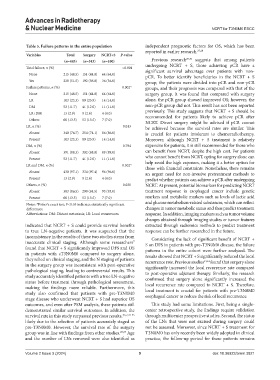
            Table 5. Failure patterns in the entire population  independent prognostic factors for OS, which has been
                                                               reported in earlier research. 27,28
            Variables        Total  Surgery  NCRT+S  P‑value
                            (n=443)  (n=343)  (n=100)            Previous research 29,30  suggests that among patients
            Total failure, n (%)                      <0.001   undergoing NCRT + S, those achieving pCR have a
                                                               significant survival advantage over patients with non-
             None           215 (48.5) 151 (44.0)  64 (64.0)   pCR. To better identify beneficiaries in the NCRT + S
             Yes            228 (51.5) 192 (56.0)  36 (36.0)   group, the patients were divided into pCR and non-pCR
            Failure patterns, n (%)                  0.002*    groups, and their prognosis was compared with that of the
             None           215 (48.5) 151 (44.0)  64 (64.0)   surgery group. It was found that compared with surgery
             LR             103 (23.3) 89 (25.9)   14 (14.0)   alone, the pCR group showed improved OS; however, the
             DM             52 (11.7)  41 (12.0)   11 (11.0)   non-pCR group did not. This result has not been reported
             LR+DM          13 (2.9)  9 (2.6)   4 (4.0)        previously. This study suggests that NCRT + S should be
                                                               recommended for patients likely to achieve pCR after
             Others         60 (13.5)  53 (15.5)   7 (7.0)     NCRT. Direct surgery might be advised if pCR cannot
            LR, n (%)                                0.013     be achieved because the survival rates are similar. This
             Absent         340 (76.7) 254 (74.1)  86 (86.0)   is crucial for  patients intolerant  to chemoradiotherapy.
             Present        103 (23.3) 89 (25.9)   14 (14.0)   Moreover,  although NCRT + S treatment is relatively
            DM, n (%)                                0.794     expensive for patients, it is still recommended for those who
             Absent         391 (88.3) 302 (88.0)  89 (89.0)   can benefit from NCRT, despite the high cost. For patients
                                                               who cannot benefit from NCRT, opting for surgery alone can
             Present        52 (11.7)  41 (12.0)   11 (11.0)
            LR and DM, n (%)                         0.502*    help avoid the high expenses, making it a better option for
                                                               those with financial constraints. Nonetheless, there remains
             Absent         430 (97.1) 334 (97.4)  96 (96.0)   an urgent need for non-invasive pretreatment methods to
             Present        13 (2.9)  9 (2.6)   4 (4.0)        predict whether patients can achieve a pCR after undergoing
            Others, n (%)                            0.030     NCRT. At present, potential biomarkers for predicting NCRT
             Absent         383 (86.5) 290 (84.5)  93 (93.0)   treatment response in esophageal cancer include genetic
             Present        60 (13.5)  53 (15.5)   7 (7.0)     markers and metabolic markers such as levels of lactic acid
            Notes: *Fisher’s exact test; P<0.05 indicates statistically significant   and glucose metabolism-related substances, which can reflect
            differences.                                       changes in tumor metabolic status and thus predict treatment
            Abbreviations: DM: Distant metastasis; LR: Local recurrences.  response. In addition, imaging markers such as tumor volume
                                                               changes obtained through imaging studies or tumor features
            indicated that NCRT + S could provide survival benefits   extracted through radiomics methods to predict treatment
            to true LN-negative patients. It was suspected that the   response can be further researched in the future.
            inconsistency in the results of these two studies stems from   Considering the lack of significant benefit of NCRT +
            inaccurate clinical staging. Although some researchers    S on DFS in patients with pre-T3N0M0 disease, the failure
                                                          7
            found that NCRT + S significantly improved DFS and OS   patterns in the entire cohort were further analyzed. The
            in  patients  with  cT3N0M0  compared  to  surgery  alone,   results showed that NCRT + S significantly reduced the local
            they relied on clinical staging, and the N staging of patients   recurrence rate. Previous studies 13,14  found that surgery alone
            in the surgery group was inconsistent with post-operative   significantly increased the local recurrence rate compared
            pathological staging, leading to controversial results. This   to post-operative adjuvant therapy. Similarly, the research
            study accurately identified patients with a true LN-negative   confirmed that surgery alone significantly increased the
            status before treatment through pathological assessment,
            making the findings more reliable. Furthermore, this   local recurrence rate compared to NCRT + S. Therefore,
                                                               local treatment is crucial for patients with pre-T3N0M0
            study also confirmed that patients with pre-T3N0M0   esophageal cancer to reduce the risk of local recurrence.
            stage disease who underwent NCRT + S had superior OS
            outcomes, and even after PSM analysis, these patients still   This study had some limitations. First, being a single-
            demonstrated similar survival outcomes. In addition, the   center retrospective study, the findings require validation
            survival rate in this study surpassed previous results, 4,5,7,22-25    through multicenter prospective studies. Second, the status
            likely due to the selection of patients accurately staged as   of  the  LNs  that  were  not  excised  during  surgery  could
            pre-T3N0M0. However, the survival rate of the surgery   not be assessed. Moreover, since NCRT + S treatment for
            group was in line with findings from other studies. 26,27  Age   T3N0M0 has only recently been widely adopted in clinical
            and the number of LNs removed were also identified as   practice, the follow-up period for these patients remains


            Volume 2 Issue 3 (2024)                         9                              doi: 10.36922/arnm.3821

