


Page 85 - ARNM-3-1
P. 85
Advances in Radiotherapy
            & Nuclear Medicine                                                Cone beam-focused GK dosimetric analysis


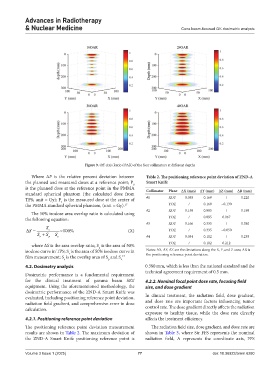
                                     Figure 9. Off-Axis Ratio (OAR) of the four collimators at different depths

              Where ∆P is the relative percent deviation between   Table 2. The positioning reference point deviation of ZND‑A
            the planned and measured doses at a reference point; P    Smart Knife
                                                          0
            is the planned dose at the reference point in the PMMA   Collimator  Plane  ΔX (mm)  ΔY (mm)  ΔZ (mm)  ΔR (mm)
            standard spherical phantom (the calculated dose from
            TPS; unit = Gy); P  is the measured dose at the center of   #1  XOY  0.038  0.169    /      0.220
                           1
            the PMMA standard spherical phantom, (unit = Gy). 17         YOZ     /      0.169  −0.130
                                                               #2        XOY    0.159   0.095    /      0.198
              The 50% isodose area overlap ratio is calculated using
            the following equation:                                      YOZ     /      0.095   0.067
                                                               #3        XOY    0.166   0.335    /      0.380
                     S
            ∆=S       c    × 100%                       (X)              YOZ     /      0.335  −0.050
                  r  + S  p  − S  S c                          #4        XOY    0.034   0.102    /      0.238
              where ∆S is the area overlap ratio; S  is the area of 50%   YOZ    /      0.102   0.212
                                           p
            isodose curve in TPS; S  is the area of 50% isodose curve in   Notes: ΔX, ΔY, ΔZ are the deviations along the X, Y, and Z axes; ∆R is
                              r
            film measurement; S  is the overlap area of S  and S r. 17  the positioning reference point deviation.
                            c
                                               p
            4.2. Dosimetry analysis                            0.380 mm, which is less than the national standard and the
                                                               technical agreement requirement of 0.5 mm.
            Dosimetric performance is a fundamental requirement
            for the clinical treatment of gamma beam SRT       4.2.2. Nominal focal point dose rate, focusing field
            equipment. Using the aforementioned methodology, the   size, and dose gradient
            dosimetric performance of the ZND-A Smart Knife was
            evaluated, including positioning reference point deviation,   In  clinical  treatment,  the  radiation  field,  dose  gradient,
            radiation field gradient, and comprehensive error in dose   and dose rate are important factors influencing tumor
            calculation.                                       control rate. The dose gradient directly affects the radiation
                                                               exposure to healthy tissue, while the dose rate directly
            4.2.1. Positioning reference point deviation       affects the treatment efficiency.
            The positioning reference point deviation measurement   The radiation field size, dose gradient, and dose rate are
            results are shown in Table 2. The maximum deviation of   shown in Table 3, where Str FFS represents the nominal
            the ZND-A Smart Knife positioning reference point is   radiation field, A represents the coordinate axis, FFS


            Volume 3 Issue 1 (2025)                         77                             doi: 10.36922/arnm.6280

