


Page 86 - ARNM-3-1
P. 86
Advances in Radiotherapy
            & Nuclear Medicine                                                Cone beam-focused GK dosimetric analysis


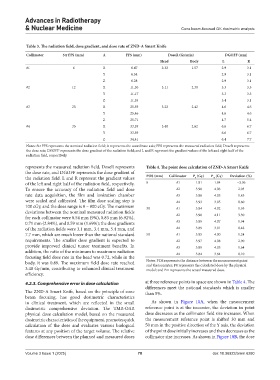
            Table 3. The radiation field, dose gradient, and dose rate of ZND‑A Smart Knife
            Collimator      Str FFS (mm)     A         FFS (mm)         DoseR (Gy/min)           DGOFF (mm)
                                                                     Head         Body          L         R
            #1                  6            X           6.47         2.32         1.57        2.9        3.1
                                             Y           6.54                                  2.9        3.1
                                             Z           6.28                                  2.9        3.1
            #2                  12           X          11.30         3.11         2.30        3.3        3.3
                                             Y          11.17                                  3.3        3.3
                                             Z          11.55                                  3.4        3.1
            #3                  25           X          25.59         3.22         2.42        4.6        4.6
                                             Y          25.46                                  4.6        4.6
                                             Z          25.71                                  4.7        5.4
            #4                  35           X          33.59         3.48         2.62        6.6        6.7
                                             Y          33.59                                  6.6        6.7
                                             Z          34.41                                  6.4        7.7
            Notes: Str FFS represents the nominal radiation field; A represents the coordinate axis; FFS represents the measured radiation field; DoseR represents
            the dose rate; DGOFF represents the dose gradient of the radiation field; and L and R represent the gradient values of the left and right half of the
            radiation field, respectively.

            represents the measured radiation field, DoseR represents   Table 4. The point dose calculation of ZND‑A Smart Knife
            the dose rate, and DGOFF represents the dose gradient of
            the radiation field. L and R represent the gradient values   POS (mm)  Collimator  P  (Gy)  P (Gy)  Deviation (%)
                                                                                    0
                                                                                            m
            of the left and right half of the radiation field, respectively.   0  #1  1.91  1.84      −3.36
            To ensure the accuracy of the radiation field and dose          #2      3.98    4.06      2.03
            rate data acquisition, the film and ionization chamber          #3      3.98    4.05      1.85
            were scaled and calibrated. The film dose scaling step is       #4      3.93    3.95      0.60
            100 cGy, and the dose range is 0 – 800 cGy. The maximum   30    #1      3.94    4.02      1.95
            deviations between the nominal measured radiation fields        #2      3.98    4.11      3.30
            for each collimator were 0.54 mm (9%), 0.83 mm (6.92%),
            0.71 mm (2.84%), and 0.59 mm (1.69%); the dose gradients        #3      3.99    4.07      1.94
            of the radiation fields were 3.1 mm, 3.4 mm, 5.4 mm, and        #4      3.89    3.91      0.48
            7.7 mm, which are much lower than the national standard   50    #1      3.95    4.00      1.24
            requirements. The smaller dose gradient is expected to          #2      3.97    4.08      2.90
            provide improved clinical tumor treatment benefits. In          #3      3.99    4.05      1.64
            addition, the ratio of the minimum to maximum radiation         #4      3.84    3.84      0.10
            focusing field dose rate in the head was 0.72, while in the
            body, it was 0.89. The maximum field dose rate reached   Notes: POS represents the distance between the measurement point
                                                               and the isocenter; P0 represents the calculated dose by the physical
            3.48 Gy/min, contributing to enhanced clinical treatment   model; and Pm represents the actual measured dose.
            efficiency.
            4.2.3. Comprehensive error in dose calculation     at three reference points in space are shown in Table 4. The
                                                               differences meet the national standards which is smaller
            The ZND-A Smart Knife, based on the principle of cone   than 5%.
            beam focusing, has good dosimetric characteristics
            in clinical treatment, which are reflected in the small   As shown in  Figure  10A, when the measurement
            dosimetric comprehensive deviation. The TMR-OAR    reference point is at the isocenter, the deviation in point
            physical dose calculation model, based on the measured   dose decreases as the collimator field size increases. When
            dosimetric characteristics of the equipment, promotes quick   the measurement reference point is shifted 30  mm and
            calculation of the dose and evaluates various biological   50 mm in the positive direction of the Y axis, the deviation
            features at any position of the target volume. The relative   of the point dose initially increases and then decreases as the
            dose differences between the planned and measured doses   collimator size increases. As shown in Figure 10B, the dose


            Volume 3 Issue 1 (2025)                         78                             doi: 10.36922/arnm.6280

