


Page 91 - ARNM-3-1
P. 91
Advances in Radiotherapy
            & Nuclear Medicine                                              Nanomaterials in cancer chemoimmunotherapy


            low immune response rates, and high selectivity for certain
            tumor types.  In addition, it may sometimes cause impaired
                      5
            immune homeostasis  (Figure 1).
                             6
              Chemotherapy, one of the principal conventional
            strategies in cancer therapy, utilizes various antineoplastic
            agents to combat cancer by either destroying tumor cells
            or inhibiting their proliferation. Chemotherapeutic drugs,
            such as cisplatin, doxorubicin, paclitaxel, methotrexate,
            and 5-fluorouracil, can easily circulate throughout the
            body through the bloodstream, making chemotherapy
            the preferred approach for metastatic cancers. The
            four most common mechanisms of action include
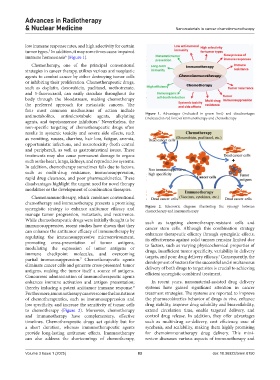
            antimetabolites,  antimicrotubule  agents,  alkylating  Figure  1. Advantages (indicated in green font) and disadvantages
                                                               (indicated in red font) of immunotherapy and chemotherapy
            agents, and topoisomerase inhibitors.  Nevertheless, the
                                           7
            non-specific  targeting  of  chemotherapeutic  drugs  often
            results in systemic toxicity and severe side effects, such
            as vomiting, nausea, diarrhea, hair loss, fatigue, anemia,
            opportunistic infections, and neurotoxicity (both central
            and peripheral), as well as gastrointestinal issues. These
            treatments may also cause permanent damage to organs
            such as the heart, lungs, kidneys, and reproductive systems.
            In addition, chemotherapy sometimes fails due to factors,
            such as multi-drug resistance, immunosuppression,
            rapid drug clearance, and poor pharmacokinetics. These
            disadvantages highlight the urgent need for novel therapy
            modalities or the development of combination therapies.
              Chemoimmunotherapy, which combines conventional
            chemotherapy and immunotherapy, presents a promising
            synergistic strategy to enhance antitumor efficacy and   Figure  2. Schematic diagram illustrating the synergy between
                                                               chemotherapy and immunotherapy
            manage tumor progression, metastasis, and recurrence.
            While chemotherapeutic drugs were initially thought to be   such  as  targeting  chemotherapy-resistant  cells  and
            immunosuppressive, recent studies have shown that they   cancer stem cells. Although this combination strategy
            can enhance the antitumor efficacy of immunotherapy by   enhances therapeutic efficacy through synergistic effects,
            regulating the immunosuppressive microenvironment,   its effectiveness against solid tumors remains limited due
            promoting cross-presentation of tumor antigens,    to factors, such as varying physicochemical properties of
            modulating the expression of tumor antigens or     drugs, insufficient tumor specificity, variability in delivery
            immune   checkpoint  molecules,  and  overcoming   targets, and poor drug delivery efficacy.  Consequently, the
                                                                                              7
            partial immunosuppression.  Chemotherapeutic agents   development of vectors for the successful and simultaneous
                                   7
            eliminate cancer cells and generate cross-presented tumor   delivery of both drugs to target sites is crucial to achieving
            antigens, making the tumor itself a source of antigens.   efficient synergistic combined treatment.
            Concurrent administration of immunotherapeutic agents
            enhances immune activation and antigen presentation;   In  recent  years,  nanomaterial-assisted  drug  delivery
            thereby inducing a potent antitumor immune response.    systems  have  gained significant  attention  in cancer
                                                          8
            Furthermore, immunotherapy can overcome the limitations   treatment strategies. The systems are reported to improve
            of chemotherapeutics, such as immunosuppression and   the pharmacokinetics behavior of drugs in vivo, enhance
            low specificity, and increase the sensitivity of tumor cells   drug stability, improve drug solubility and bioavailability,
            to chemotherapy (Figure  2). Moreover, chemotherapy   extend circulation time, enable targeted delivery, and
            and immunotherapy have complementary, effective    control drug release. In addition, they offer advantages
            timelines. Chemotherapeutic drugs act quickly but for   such as multi-drug co-delivery, cost efficiency, ease of
            a  short  duration,  whereas  immunotherapeutic  agents   synthesis, and scalability, making them highly promising
            provide long-lasting antitumor effects. Immunotherapy   for chemoimmunotherapy drug delivery. This mini-
            can also address the shortcomings of chemotherapy,   review discusses various aspects of immunotherapy and


            Volume 3 Issue 1 (2025)                         83                             doi: 10.36922/arnm.8150

