


Page 92 - ARNM-3-1
P. 92
Advances in Radiotherapy
            & Nuclear Medicine                                              Nanomaterials in cancer chemoimmunotherapy


            chemoimmunotherapy  in cancer  treatment,  as well  as   For instance, vaccines against the hepatitis B virus are
            summarizes the different nanomaterial-assisted drug   used to reduce the incidence of hepatocellular carcinoma
            delivery systems employed in chemoimmunotherapy.   in patients with chronic liver disease.  Similarly, vaccines
                                                                                             11
                                                               targeting human papillomavirus are employed to prevent
            2. Cancer immunotherapy                            cancers of the vagina, cervix, and throat.  For therapeutic
                                                                                               12
            Immunotherapy is a therapeutic strategy for treating cancer   purposes, Sipuleucel-T (Provenge) was developed as the
            that enhances the patient’s natural defense mechanisms to   first commercial cancer vaccine for treating prostate cancer.
                                                                                              13
            combat the disease. In recent years, cancer immunotherapy   This is a dendritic cell-based vaccine.  On the contrary,
            has gained significant attention as a powerful therapeutic   talimogene laherparepvec (T-VEC; Imlygic) is an oncolytic
            approach. The cancer-immunity cycle, which underpins   herpes  simplex  virus  vaccine  used  to  treat  metastatic
                                                                        14
            cancer immunity, consists of several key steps, including   melanoma.  In addition, several other cancer vaccines
            the release of cancer-cell antigens, presentation of   are  currently  being  developed  and undergoing clinical
            these antigens by antigen-presenting cells, priming and   trials, including the GVAX lung cancer vaccine (CG 8123),
            activation of T cells, the transportation and infiltration of   glycoprotein 100 (GP 100) vaccines, and the NY-ESO-1
            T cells into tumors, recognition of cancer cells by T cells,   plasmid deoxyribonucleic acid vaccine (pPJV7611),
            and the subsequent killing of cancer cells by cytotoxic T   among others. Cancer vaccines are often combined with
            cells.  Therefore, it is theoretically possible to target each   adjuvants to activate the immune system  and generate
                9
            of these steps with various methods to achieve therapeutic   robust immune responses against cancer. These adjuvants
            benefits. Over the past few decades, numerous cancer   typically include microbes and microbial derivatives
            immunotherapy strategies have been developed, including   (e.g.,  cytosine-phosphate-diester  guanine),  cytokines/
            vaccines, adoptive cell therapy, therapeutic antibodies, and   endogenous  immunomodulators  (e.g.,  granulocyte-
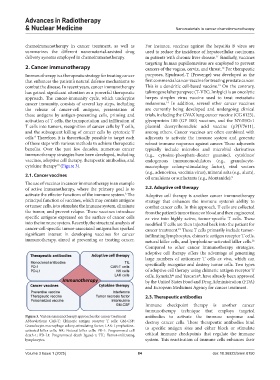
            cytokine therapy  (Figure 3).                      macrophage colony-stimulating factor), viral vectors
                         10
                                                               (e.g., adenovirus, vaccinia virus), mineral salts (e.g., alum),
            2.1. Cancer vaccines
                                                               oil emulsions or surfactants (e.g., Montanide). 9
            The use of vaccines in cancer immunotherapy is an example
            of  active  immunotherapy, where  the  primary  goal  is  to   2.2. Adoptive cell therapy
            activate the effector functions of the immune system.  The   Adoptive cell therapy is another cancer immunotherapy
                                                      6
            principal function of vaccines, which may contain antigens   strategy that enhances the immune system’s ability to
            or tumor cells, is to stimulate the immune system, eliminate   combat cancer cells. In this approach, T cells are collected
            the tumor, and prevent relapse. These vaccines introduce   from the patient’s tumor tissue or blood and then engineered
            specific antigens expressed on the surface of cancer cells   ex vivo into highly active, tumor-specific  T cells.  These
            into the immune system. Recently, the structural analysis of   modified T cells are then injected back into the patient for
            cancer-cell-specific tumor-associated antigens has sparked   cancer treatment.  These T cells primarily include tumor-
                                                                             15
            significant interest in developing vaccines for cancer   infiltrating lymphocytes, chimeric antigen receptor T cells,
            immunotherapy, aimed at preventing or treating cancer.   natural killer cells, and lymphokine-activated killer cells.
                                                                                                            16
                                                               Compared  to  other  cancer  immunotherapy  strategies,
                                                               adoptive cell therapy offers the advantage of generating
                                                               large numbers of anticancer T cells  ex  vivo, which can
                                                               specifically recognize and destroy tumor cells. Two types
                                                               of adoptive cell therapy using chimeric antigen receptor T
                                                                          ®
                                                               cells, Kymriah  and Yescarta , have already been approved
                                                                                     ®
                                                               by the United States Food and Drug Administration (FDA)
                                                               and European Medicines Agency for cancer treatment.
                                                               2.3. Therapeutic antibodies
                                                               Immune checkpoint therapy is another cancer
                                                               immunotherapy technique that employs targeted
            Figure 3. Various immunotherapy approaches for cancer treatment  antibodies to activate the immune response and
            Abbreviations: CAR-T: Chimeric antigen receptor T cells; GM-CSF:   destroy  cancer  cells. These therapeutic  antibodies  bind
            Granulocyte-macrophage colony-stimulating factor; LAK: Lymphokine-  to specific antigen sites and either block or stimulate
            activated killer cells; NK: Natural killer cells; PD-1: Programmed cell
            death-1;  PD-L1: Programmed  death ligand-1;  TIL:  Tumor-infiltrating   critical immune checkpoints that  regulate  the immune
            lymphocytes.                                       system. This reactivation of immune cells enhances their

            Volume 3 Issue 1 (2025)                         84                             doi: 10.36922/arnm.8150

