


Page 85 - DP-2-1
P. 85
Design+                                                               Analysis of 3D-printed anisotropic cells


            mode of FFF objects under severe compression.  This   technical drawings to constrain fabrication parameters and
                                                     4,7
            approach was also adopted by several other studies. 8-21  For   predict mechanical behavior without requiring intensive
            example, Li and Wang  studied the mechanical behavior   computational methods.
                              22
            of  3D  printing  sandwiches  against  bending  load.  Many   For the first two parts of this study, we established
            studies also indicated the effect of process parameters on   three infill strategies to be analyzed: raster (with 100%
            anisotropic behavior. 4,5,23,24                    density), grid, and hexagonal infill. For each one of these
              However, there are not many investigations on the   infill strategies, we have applied a multivariable analysis
            connection between process parameters and the mechanical   method, where the experiment design was full (2  for 100%
                                                                                                     4
            strength of FFF items in a computational environment to   density raster and 2  for grid and hexagonal infill) with two
                                                                              3
            support design specifications and technical drawings.  levels and no central point. The control factors considered
                                                               were raster orientation (α), distance between lines (d),
              The complexity of objects and their fabrication
            parameters can lead to specifications that are not well-  layer thickness (h), and bead width (w) for 100% density
                                                               raster. For grid infill, we established the distance between
            defined. For instance, in building infill strategies, identical   lines (d), layer thickness (h), and bead width (w) as control
            geometries can yield objects with vastly different mechanical
            properties. This issue highlights a broader problem with   factors. On the other hand, hexagon diameter (hex), layer
            inadequate design specifications and outdated technical   thickness (h), and bead width (w) were selected as control
                                                               factors for hexagonal infill.
            drawing standards. Addressing this challenge, the primary
            objective of this study is to introduce a new approach   The main responses of this study were young modulus,
            for specifying additive manufacturing objects that take   Poisson ratios, maximum internal stress, and maximum
            into account their mechanical anisotropy. The study is   equivalent stress (based on external  dimensions  of
            organized into four sections: numerical characterization,   specimen cross-section). In addition, we identified the
            experimental characterization, development of a new   contribution  of  the  control  factors  for  a  generalized
            specification method, and evaluation of the proposed   orthotropic compliance matrix. This generalized matrix
            method.  The  central  idea  is  to  integrate  simplified   was developed to create a simplified numerical simulation
            anisotropic cells into 3D models and technical drawings   that is both computationally efficient and easily integrated
            to ensure that the final object aligns with both the   into technical specifications.
            specifications and simulated results. Furthermore, this   We utilized Ansys Workbench for finite element analysis,
            approach facilitates topological optimization by creating   Minitab for data processing, and Matlab for numerical
            objects based on a flexible cost function, allowing half of   modeling. Experimental analysis  was conducted using  a
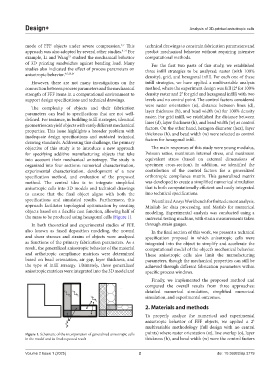
            the mass to be produced using hexagonal cells (Figure 1).  universal testing machine, with strain measurements taken
              In both theoretical and experimental studies of FFF,   through strain gauges.
            also known as fused deposition modeling, the normal   In the final section of this work, we present a technical
            and shear stresses and strains of objects were analyzed   specification proposal in which anisotropic cells were
            as functions of the primary fabrication parameters. As a   integrated into the object to simplify and accelerate the
            result, the generalized anisotropic behavior of the material   computational model of the object’s mechanical behavior.
            and orthotropic compliance matrices were determined   These  anisotropic  cells  also  limit  the  manufacturing
            based on bead orientation, air gap, layer thickness, and   parameters, though the mechanical properties can still be
            the type of infill strategy. Ultimately, these generalized   achieved through different fabrication parameters within
            anisotropic matrices were integrated into the 3D model and   specific process windows.

                                                                 Finally, we implemented the proposed method and
                                                               compared the overall results from three approaches:
                                                               detailed numerical simulation, simplified numerical
                                                               simulation, and experimental outcomes.

                                                               2. Materials and methods
                                                               To properly analyze the numerical and experimental
                                                                                                             k
                                                               anisotropic behavior of FFF objects, we applied a 2
                                                               multivariable methodology (full design with no central
            Figure 1. Schematic of the incorporation of generalized anisotropic cells   points) where raster orientation (α), line overlap (o), layer
            in the model and its final expected result         thickness (h), and bead width (w) were the control factors


            Volume 2 Issue 1 (2025)                         2                                doi: 10.36922/dp.3779

