


Page 86 - DP-2-1
P. 86
Design+                                                               Analysis of 3D-printed anisotropic cells


            for 100% density raster. For grid infill, the analyzed control   air gap, and layer height. The general idea of overlap and
            factors were air gap (d), layer thickness (h), and bead width   hexagon diameter are also represented in this figure. The
            (w). On the other hand, we established hexagon diameter   hexagon diameter refers to the parameter that controls
            (hex), layer thickness (h), and bead width (w) as control   the shape of a hexagonal honeycomb. In this case, the
            factors of the hexagonal infill design.            hexagon is inscribed into a circle with a diameter equal
                                                               to  the  hexagon  diameter.  This  parameter  represents  a
              We defined the equivalent maximum permissible
            stress, which is based on the external dimensions of the   novel infill parameter, as most slicers calculate the infill
            specimen, and the maximum internal permissible stress   based on density proportion. It is important to note that
                                                               density parameters typically result in variations in infill
            as the responses. Furthermore, we analyzed the relative   shapes, which, in turn, produce differing anisotropic
            Young’s modulus, Poisson’s ratios, strains, normal stresses,
            and shear stresses to determine generalized orthotropic   effects.
            matrices as a function of fabrication parameters.    Conversely, filament overlap is a variation of the air gap
                                                               that represents a negative air gap. As a result, even if the infill
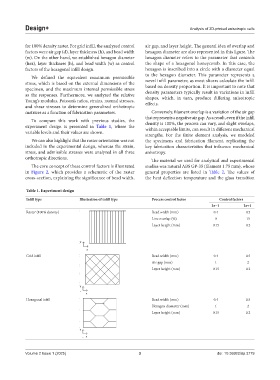
              To compare this work with previous studies, the
            experiment design is presented in  Table  1, where the   density is 100%, the process can vary, and slight overlaps,
                                                               within acceptable limits, can result in different mechanical
            variable levels and their values are shown.
                                                               strengths. For the finite element analysis, we modeled
              We can also highlight that the raster orientation was not   the specimens and fabrication filament, replicating the
            included in the experimental design, whereas the strain,   key fabrication characteristics that influence mechanical
            stress, and admissible stresses were analyzed in all three   anisotropy.
            orthotropic directions.                              The material we used for analytical and experimental
              The core concept of these control factors is illustrated   studies was natural ABS GP-35 (filament 1.75 mm), whose
            in  Figure  2, which provides a schematic of the raster   general properties are listed in  Table  2. The values of
            cross-section, explaining the significance of bead width,   the heat deflection temperature and the glass transition


            Table 1. Experiment design
            Infill type            Illustration of infill type    Process control factor      Control factors
                                                                                           Lv−1          Lv+1
            Raster (100% density)                                 Bead width (mm)           0.4           0.5
                                                                  Line overlap (%)          0             15
                                                                  Layer height (mm)         0.15          0.2


            Grid infill                                           Bead width (mm)           0.4           0.5
                                                                  Air gap (mm)              1             2
                                                                  Layer height (mm)         0.15          0.2


            Hexagonal infill                                      Bead width (mm)           0.4           0.5
                                                                  Hexagon diameter (mm)     1             2
                                                                  Layer height (mm)         0.15          0.2


            Volume 2 Issue 1 (2025)                         3                                doi: 10.36922/dp.3779

