


Page 87 - DP-2-1
P. 87
Design+                                                               Analysis of 3D-printed anisotropic cells


            Table 2. General properties of natural ABS 25      A                               B
            Property               Standard          Value
            Tensile strength       ASTM D638         36 MPa
            Young’s modulus        ASTM D638         2.4 GPa
            Flexural strength      ASTM D790         61 MPa
            Flexural modulus       ASTM D790         2.3 GPa
                                                                                               C
            Elongation at break    ASTM D638          4%
            HDT 1.82 Mpa           ASTM D648          93°C
            Abbreviation: HDT: Heat deflection temperature.

            temperature (TG) - ASTM D7028 (−83°C) of the material
            indicate the thermal workability of the material.

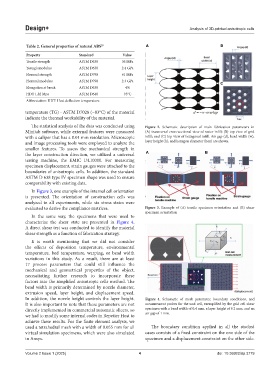
              The statistical analysis of the data was conducted using   Figure  2.  Schematic  description  of  main  fabrication  parameters  in
            Minitab software, while external features were measured   (A) transversal cross-sectional view of raster infill; (B) top view of grid
            with a caliper that has a 0.01 mm resolution. Microscopic   infill; and (C) top view of hexagonal infill. Air gap (d), bead width (w),
            and image processing tools were employed to analyze the   layer height (h), and hexagon diameter (hex) are shown.
            smaller features. To assess the mechanical strength in
            the layer construction direction, we utilized a universal   A               B
            testing machine, the EMIC DL10000. For measuring
            specimen displacement, strain gauges were attached to the
            boundaries of anisotropic cells. In addition, the standard
            ASTM D 638 type IV specimen shape was used to ensure
            comparability with existing data.
              In Figure 3, one example of the internal cell orientation
            is presented. The orientation of construction cells was
            analyzed  in all experiments,  while  six  stress  states  were
            evaluated to derive the compliance matrices.       Figure  3. Example of (A) tensile specimen orientation and (B) shear
                                                               specimen orientation
              In the  same way, the  specimens that were  used to
            characterize the shear state are presented in  Figure  4.
            A direct shear test was conducted to identify the material
            shear strength as a function of fabrication strategy.
              It is worth mentioning that we did not consider
            the effects of deposition temperature, environmental
            temperature, bed temperature, warping,  or bead width
            variations in this study. As a result, there are at least
            17 process parameters that could still influence the
            mechanical and geometrical properties of the object,
            necessitating further research to incorporate these
            factors into the simplified anisotropic cells method. The
            bead width is primarily determined by nozzle diameter,
            extrusion speed, layer height, and displacement speed.
            In addition, the nozzle height controls the layer height.   Figure  4. Schematic of mesh parameter, boundary conditions, and
            It is also important to note that these parameters are not   measurement probes for the unit cell, exemplified by the grid cell shear
            directly implemented in commercial automatic slicers, so   specimen with a bead width of 0.4 mm, a layer height of 0.2 mm, and an
            we had to modify some internal codes in Repetier Host to   air gap of 1 mm.
            achieve these results. For the finite element analysis, we
            used a tetrahedral mesh with a width of 0.055 mm for all   The boundary condition applied in all the studied
            virtual simulation specimens, which were also simulated   cases consists of a fixed constraint on the one side of the
            in Ansys.                                          specimen and a displacement constraint on the other side.


            Volume 2 Issue 1 (2025)                         4                                doi: 10.36922/dp.3779

