


Page 90 - DP-2-1
P. 90
Design+                                                               Analysis of 3D-printed anisotropic cells


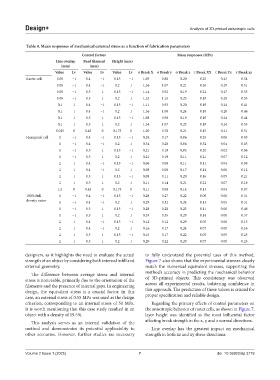
            Table 4. Mean responses of mechanical external stress as a function of fabrication parameters
                                    Control factors                         Mean responses (MPa)
                         Line overlap   Bead filament   Height (mm)
                           (mm)        (mm)
                        Value   Lv  Value   Lv   Value  Lv  σ Break X  σ Break y  σ Break z τ Break XY τ Break Yz  τ Break xz
            Raster cell  0.05   −1    0.4   −1    0.15  −1    1.09    0.88    0.20    0.25     0.23     0.54
                         0.05   −1    0.4   −1    0.2   1     1.36    1.07    0.21    0.26     0.29     0.51
                         0.05   −1    0.5   1     0.15  −1    1.14    0.92    0.19    0.22     0.27     0.55
                         0.05   −1    0.5   1     0.2   1     1.32    1.15    0.25    0.19     0.28     0.53
                          0.1   1     0.4   −1    0.15  −1    1.11    0.93    0.20    0.19     0.24     0.41
                          0.1   1     0.4   −1    0.2   1     1.36    1.00    0.24    0.18     0.28     0.46
                          0.1   1     0.5   1     0.15  −1    1.08    0.90    0.19    0.19     0.24     0.44
                          0.1   1     0.5   1     0.2   1     1.34    1.07    0.23    0.19     0.24     0.55
                         0.025  0    0.45   0    0.175  0     1.20    0.78    0.21    0.15     0.21     0.51
            Hexagonal cell  1   −1    0.4   −1    0.15  −1    0.24    0.17    0.06    0.25     0.06     0.05
                          1     −1    0.4   −1    0.2   1     0.34    0.20    0.06    0.32     0.04     0.05
                          1     −1    0.5   1     0.15  −1    0.21    0.19    0.05    0.20     0.02     0.06
                          1     −1    0.5   1     0.2   1     0.21    0.19    0.11    0.21     0.07     0.12
                          2     1     0.4   −1    0.15  −1    0.06    0.08    0.11    0.11     0.04     0.08
                          2     1     0.4   −1    0.2   1     0.08    0.08    0.17    0.14     0.06     0.12
                          2     1     0.5   1     0.15  −1    0.08    0.11    0.20    0.16     0.09     0.21
                          2     1     0.5   1     0.2   1     0.11    0.14    0.21    0.22     0.07     0.18
                          1.5   0    0.45   0    0.175  0     0.11    0.08    0.14    0.13     0.04     0.07
            100% Full     1     −1    0.4   −1    0.15  −1    0.28    0.27    0.22    0.09     0.06     0.31
            density raster  1   −1    0.4   −1    0.2   1     0.29    0.32    0.24    0.13     0.05     0.31
                          1     −1    0.5   1     0.15  −1    0.28    0.28    0.23    0.11     0.06     0.46
                          1     −1    0.5   1     0.2   1     0.39    0.35    0.29    0.14     0.08     0.37
                          2     1     0.4   −1    0.15  −1    0.12    0.12    0.29    0.05     0.06     0.15
                          2     1     0.4   −1    0.2   1     0.16    0.17    0.24    0.07     0.08     0.16
                          2     1     0.5   1     0.15  −1    0.15    0.17    0.22    0.05     0.09     0.25
                          2     1     0.5   1     0.2   1     0.20    0.22    0.29    0.07     0.08     0.25


            designers, as it highlights the need to evaluate the actual   to  fully  understand  the  potential  uses  of  this  method.
            strength of an object by considering both internal infill and   Figure 7 also shows that the experimental stresses closely
            external geometry.                                 match the numerical equivalent stresses,  supporting  the
              The difference between average stress and internal   method’s accuracy in predicting the mechanical behavior
            stress is noticeable, primarily due to the orientation of the   of 3D-printed objects. This consistency was observed
            filaments and the presence of internal gaps. In engineering   across all experimental results, bolstering confidence in
            design, the equivalent stress is a crucial factor. In this   this approach. The prediction of these values is crucial for
            case, an external stress of 0.55 MPa was used as the design   proper specification and reliable design.
            criterion, corresponding to an internal stress of 50 MPa.   Regarding the primary effects of control parameters on
            It is worth mentioning that this case study resulted in an   the anisotropic behavior of raster cells, as shown in Figure 7,
            object with a density of 19.5%.                    layer height was identified as the most influential factor
              This  analysis  serves  as  an  internal  validation  of the   affecting break strength in the x, y, and z normal directions.
            method and demonstrates its potential applicability to   Line overlap has the greatest impact on mechanical
            other  scenarios.  However,  further  studies  are necessary   strength in both xz and xy shear directions.


            Volume 2 Issue 1 (2025)                         7                                doi: 10.36922/dp.3779

