


Page 94 - DP-2-1
P. 94
Design+                                                               Analysis of 3D-printed anisotropic cells


            usually have 100% material density. By considering the type   In the case study, we analyzed the specimen using
            of cell and its stress levels, object topology can be optimized   a detailed finite element method and compared it with
            based on the anisotropic cell type and fabrication parameters.  a simplified finite element method featuring linear
                                                               orthotropic  stiffness cells. In  addition,  the  physical
              Statistical analysis was performed using  t-tests and
            F-tests to determine differences in mean and variance. The   specimen was evaluated to assess the accuracy of the
            results indicated that hexagonal and grid cells statistically   numerical models.
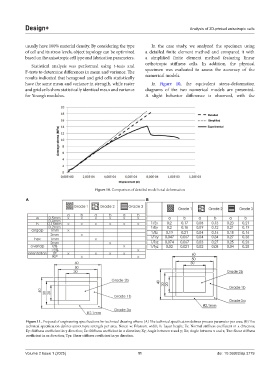
            have the same mean and variance in strength, while raster   In  Figure  10, the equivalent stress-deformation
            and grid cells show statistically identical mean and variance   diagrams of the two numerical models are presented.
            for Young’s modulus.                               A  slight behavior difference is observed, with the


                                         Figure 10. Comparison of detailed model total deformation
            A                                                  B


            Figure 11. Proposal of engineering specifications for technical drawing where: (A) The technical specification defines process parameter per area; (B) The
            technical specification defines anisotropic strength per area. Notes: w: Filament width; h: Layer height; Ex: Normal stiffness coefficient in x direction;
            Ey: Stiffness coefficient in y direction; Ez: Stiffness coefficient in z direction; Xy; Angle between x and y; Xz; Angle between x and z; Txz: Shear stiffness
            coefficient in xz direction; Tyx: Shear stiffness coefficient in yx direction.


            Volume 2 Issue 1 (2025)                         11                               doi: 10.36922/dp.3779

