Page 91 - DP-2-1
P. 91

Design+                                                               Analysis of 3D-printed anisotropic cells


            A                                                  physical object often contains porosities. These porosities
                                                               lead to a reduction in the actual density of the object, which
                                                               varies depending on the layer height and filament diameter.
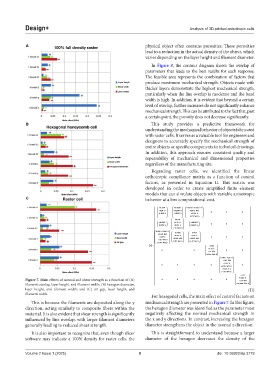
                                                                 In  Figure  8, the contour diagram shows the overlap of
                                                               parameters that leads to the best results for each response.
                                                               The feasible area represents the combination of factors that
                                                               produce maximum mechanical strength. Objects made with
                                                               thicker layers demonstrate the highest mechanical strength,
                                                               particularly when the line overlap is moderate and the bead
                                                               width is high. In addition, it is evident that beyond a certain
                                                               level of overlap, further increases do not significantly enhance
                                                               mechanical strength. This can be attributed to the fact that, past
                                                               a certain point, the porosity does not decrease significantly.
            B                                                    This study provides a predictive framework for
                                                               understanding the mechanical behavior of objects fabricated
                                                               with raster cells. It serves as a valuable tool for engineers and
                                                               designers to accurately specify the mechanical strength of
                                                               entire objects or specific components in technical drawings.
                                                               In addition, this approach ensures consistent quality and
                                                               repeatability of mechanical and dimensional properties
                                                               regardless of the manufacturing site.
                                                                 Regarding raster cells, we identified the linear
                                                               orthotropic compliance matrix as a function of control
                                                               factors, as presented in Equation II. This matrix was
                                                               developed in order to create simplified finite element
                                                               models that can simulate objects with variable anisotropic
            C                                                  behavior at a low computational cost.

                                                                      + 0.2894    + 0.06005   − 0.0038 0.01075 O−  ⋅   
                                                                       0.09 O  ⋅    −  0.0198 O  ⋅    +  0.033 Wd⋅    
                                                                       − −   0.2889 h⋅       − 0.0747 h⋅        + 0.188 h⋅      0  0  0   
                                                                                  0.191.Wd h⋅      
                                                                               −                     
                                                                           +  0.148                     
                                                                     + 0.0505     + 1.25 O    + 0.01011   
                                                                             ⋅
                                                                                      0     0      0  
                                                                       0.0789 h  −  ⋅   + 0.291 h ⋅      0.0672 h  +  ⋅    
                                                                           −  ⋅  ⋅                      
                                                                           7.36 Wd O                    
                                                                    + 0.081 0.588 O−  ⋅                 
                                                                     0.160 Wd⋅      +  0.1085      +  0.419    
                                                                     −       0.471 h  −   ⋅  −  2.01 h⋅     
                                                                     −   0.507 h⋅            0  0  0  
                                                                     1.302 Wd O⋅  ⋅         − 0.265 Wd⋅    − 0.842 Wd⋅    
                                                                      −   1.586 Wd h  +   ⋅  ⋅         +  1.89 Wd h⋅  ⋅          +  6.19 Wd h⋅  ⋅       
                                                                  C=                − 0.786         
                                                                                           +  6.13 h ⋅      
                                                                     0            0      .1.91 Wd    0  0  
                                                                                           ⋅
                                                                                                          
                                                                                           −  10.44 Wd h ⋅ ⋅      
                                                                                                          
                                                                                             + 0.901 7.23 O  
                                                                                                   ⋅
                                                                                                 −
                                                                                               −  1.241 Wd    
                                                                                                  ⋅
                                                                                                        
                                                                                               −  2.527 h ⋅    
                                                                     0     0      0       0          0  
                                                                                              +   8.25 Wd O   ⋅  ⋅  
                                                                                               17.53 O h  +  ⋅⋅  
                                                                                                        
                                                                                              +   4.84 Wd h ⋅ ⋅    
                                                                                                          
                                                                                                        −  2.24      
                                                                                                       12.83 h ⋅
            Figure 7. Main effects of normal and shear strength as a function of (A)         0  0  0  0  0      −  +  5.14 Wd          
                                                                                                        ⋅
                                                                                                           
            filament overlap, layer height, and filament width; (B) hexagon diameter,                  −  28.4028 Wd h ⋅ ⋅      
            layer height, and filament width; and (C) air gap, layer height, and                           (II)
            filament width.
                                                                 For hexagonal cells, the main effect of control factors on
              This is because the filaments are deposited along the y   mechanical strength are presented in Figure 7. In this figure,
            direction, acting similarly to composite fibers within the   the hexagon diameter was identified as the parameter most
            material. It is also evident that shear strength is significantly   negatively affecting the normal mechanical strength in
            influenced by line overlap, with larger filament diameters   the x and y directions. In contrast, increasing the hexagon
            generally leading to reduced shear strength.       diameter strengthens the object in the normal z direction.
              It is also important to recognize that, even though slicer   This is straightforward to understand because a larger
            software may indicate a 100% density for raster cells, the   diameter of the hexagon decreases the density of the
            Volume 2 Issue 1 (2025)                         8                                doi: 10.36922/dp.3779
   86   87   88   89   90   91   92   93   94   95   96