


Page 85 - DP-2-3
P. 85
Design+                                         Evaluation of recreational suitability of urban waterfront green spaces


                                              Figure 6. Weight chart of secondary indicators

            level is recreational experience elements > landscape   Table 6. Visitor demographic statistics
            elements > environmental elements > resource elements >   Category  Subcategory  Count  Proportion (%)
            facility elements > location and transportation elements. This
            indicates that when evaluating the recreational suitability   Gender  Male      101       34
            of Linyi’s waterfront green spaces, greater emphasis was          Female        199       66
            placed on whether the recreational experience met people’s   Age  <18            9         3
            needs. Second, the construction of landscapes and the             18–25         45        15
            environment was also considered an important factor. The          26–30         62        21
            aspects of facilities and location/transportation had relatively   31–40        71        24
            less impact on the evaluation results. Among the first-level
            indicators, natural landscape, recreational space, recreational   41–50         61        20
            activities, and natural resources recorded high weights. These    51–60         23         8
            factors are often limited in urban environments, resulting in     >60           29        10
            increased demand from tourists, which is reflected in their   Transportation mode Walking  94  31
            high weight proportions. It can be concluded from Figure 6        Cycling       94        31
            that among the secondary indexes, the comfort and safety          Driving       86        29
            of recreational spaces ranked highest. This indicates that the    Public transit  26       9
            introduction of safe and comfortable recreational spaces in
            urban waterfront green spaces has a significant impact on the   Visit frequency  Rarely  43  14
            evaluation of recreational suitability.                           Occasionally  128       43
                                                                              Frequently    129       43
              In Yang’s  evaluation of urban wetland park recreational
                     32
            suitability based on multivariate data, a rating system with
            28 factors was developed, with the recreational landscape   the  square  primarily attracts  predominantly  adulthood  and
            recorded the highest weight, highlighting its importance.   middle-aged tourists between 26 and 50 years old. Owing to the
            Similarly, in the evaluation system constructed by Guo   superior geographical location and convenient transportation
            et al. , 25 indicator layers were selected, with the recreational   access of Linyi Calligraphy Square, visitors frequently visit this
               49
            environment criteria exhibiting the highest weight. In   place for recreation, with most traveling by bicycle or on foot. In
            contrast, the current study established an evaluation   addition, some visitors visit by private car.
            system with 43  secondary indicators, providing a more
            comprehensive selection of evaluation indicators. Among   3.3. Recreational suitability evaluation of Linyi
            these, recreational experience and landscape elements   Calligraphy Square
            received higher weights, aligning with previous studies.  After collating the tourists’ evaluations of Linyi Calligraphy
            3.2. Visitor demographics                          Square, the survey results of the soft indicators are
                                                               summarized in Table 7.
            As can be seen from Table 6, the majority of tourists visiting Linyi
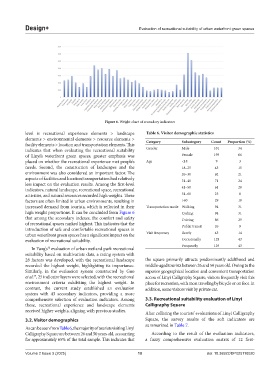
            Calligraphy Square are between 26 and 50 years old, accounting   According  to  the  result  of  the  evaluation  indicators,
            for approximately 65% of the total sample. This indicates that   a fuzzy comprehensive evaluation matrix of 12 first-


            Volume 2 Issue 3 (2025)                         10                           doi: 10.36922/DP025110020

