


Page 112 - EER-2-1
P. 112
Explora: Environment
            and Resource                                           Carbon neutrality and low-carbon behavior in space tourism


            a “COVID-19 positive  information awareness-travel   comprises six constructs and 24 items, including questions
            motivation-behavioral intention” pathway.  This literature   on LCM (five items), 29,32,47  low-carbon space tourism
                                              41
            underscores the mediating factor of tourism motivation.   awareness (five items), 22,48,49  low-carbon space tourism
            Therefore,  we posit that  tourism  motivation,  specifically   behavioral  intention  (three  items), 50-52   and  perceived
            low-carbon tourism  motivation,  serves  as a  mediating   intensity of the “carbon neutrality” in space tourism (11
            variable, and the emerging concept of low-carbon space   items).  Reliability and validity tests were conducted to
                                                                    8
            tourism motivation merits inclusion in this discussion.   confirm a qualified measurement tool utilizing a seven-
            Therefore, the hypothesis is drawn:                point Likert scale ranging from 1 denoting strongly
            H : Tourists’ low-carbon motivation has a mediating effect   disagree to 7 indicating strongly agree ; (Appendix).
                                                                                             45
             7
               between the perceived carbon neutrality goal and low-
               carbon tourism behavioral intention in space tourism.  3.2. Data collection
                                                               As few tourists have traveled to space, and the costs
            2.6. The mediating effect between low-carbon       entailed are exorbitant, the interviewees surveyed were all
            awareness and behavioral intention                 potential tourists willing to travel to space, mainly students
            Integrating the “dual carbon” strategy into low-carbon   from Macao and Zhuhai.
            tourism requires public recognition of carbon neutrality.   Data were collected from November to December
            In the framework of “Awareness-Willingness-Behavior,”   2023 through online platforms (Xiaohongshu, WeChat,
            awareness serves as the foundation, willingness as the   and QQ groups)  after  performing convenience  and
            prerequisite, and behavior as the outcome. 42,43  Domestic   snowballing sampling. Individuals aged 18 years or older
            research also indicates that low-carbon awareness   and interested in participating in space tourism were
            mediates the link between “dual carbon” strategies and   invited to participate. Five hundred and fifty subjects were
            low-carbon willingness.  As protective policies aimed at   invited, and 550 panel members completed the survey with
                               44
            environmental conservation and tourism’s low-carbon   valid responses. After the respondents who took <1 min
            development, the “dual carbon” strategy and carbon   to finish the questionnaire were excluded, the data and
            neutrality goal complement well with each other. Guided   questionnaire responses of the remaining 416 potential
            by supply-side policies, awareness precedes willingness,   space tourists were subjected to analysis using Statistical
            leading to the proposed hypothesis of the “policy event-  Package for the Social Sciences and Mplus software,
            awareness-behavioral intention” pathway. Therefore,  the   and various mathematical and statistical methods such
            following hypothesis is drawn:                     as reliability analysis, validity analysis, factor analysis,
            H : Tourists’ LCA mediates between the perceived carbon   correlation analysis, common method variance (CMV)
             8
               neutrality goal and the behavioral intention of low-  analysis, and structural equation modeling (SEM) were
               carbon space tourism.                           used to analyze the survey data.
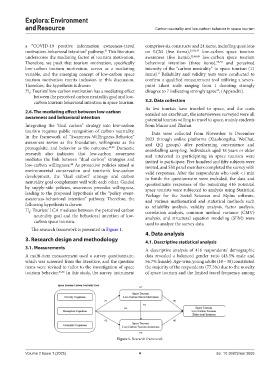
              The research framework is presented in Figure 1.
                                                               4. Data analysis
            3. Research design and methodology                 4.1. Descriptive statistical analysis
            3.1. Measurements                                  A  descriptive  analysis  of 416  respondents’ demographic
            A multi-item measurement used a survey questionnaire,   data revealed a balanced gender ratio (43.3% male and
            which was screened from the literature, and the question   56.7% female). Age-wise, young adults (18 – 30) constituted
            items were revised to tailor to the investigation of space   the majority of the respondents (77.3%) due to the novelty
            tourism behavior. 45,46  In this study, the survey instrument   of space tourism and the limited travel frequency among


                                                   Figure 1. Research framework


            Volume 2 Issue 1 (2025)                         4                                doi: 10.36922/eer.3655

