


Page 117 - EER-2-1
P. 117
Explora: Environment
            and Resource                                           Carbon neutrality and low-carbon behavior in space tourism


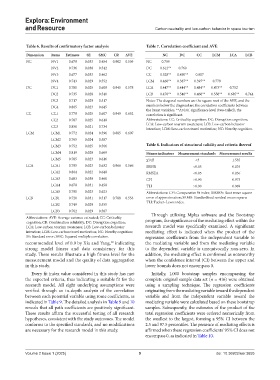
            Table 6. Results of confirmatory factor analysis   Table 7. Correlation coefficient and AVE
            Dimension  Items  Estimate  SE  SMC  CR   AVE             NC     DC      CC    LCM     LCA   LCB
            NC         NV1    0.678  0.033  0.454  0.802  0.503  NC   0.709
                       NV2    0.736  0.030  0.542              DC    0.612**  0.760
                       NV3    0.677  0.033  0.462              CC    0.528**  0.490**  0.807
                       NV4    0.743  0.029  0.552              LCM   0.460**  0.387**  0.397**  0.779
            DC         DC1    0.780  0.025  0.608  0.845  0.578  LCA  0.447**  0.444**  0.484**  0.473**  0.752
                       DC2    0.735  0.028  0.540              LCB   0.470**  0.546**  0.466**  0.556**  0.685**  0.744
                       DC3    0.717  0.029  0.517              Notes: The diagonal numbers are the square root of the AVE, and the
                       DC4    0.805  0.023  0.645              numbers below the diagonal are the correlation coefficients between
                                                               the latent variables. **At 0.01 significance level (two-tailed), the
            CC         CC1    0.778  0.025  0.607  0.849  0.652  correlation is significant.
                       CC2    0.787  0.025  0.618              Abbreviations: CC: Criticality cognition; DC: Disruption cognition;
                       CC3    0.856  0.021  0.734              LCA: Low-carbon tourism awareness; LCB: Low-carbon behavior
                                                               intention; LCM: Low-carbon travel motivation; NC: Novelty cognition.
            LCM        LCM1   0.772  0.024  0.596  0.885  0.607
                       LCM2   0.765  0.024  0.587
                       LCM3   0.752  0.025  0.566              Table 8. Indicators of structural validity and criteria thereof
                       LCM4   0.819  0.020  0.669              Fitness indicators  Measurement standards Measurement results
                       LCM5   0.785  0.023  0.616              χ /df                <3              1.535
                                                                2
            LCA        LCA1   0.795  0.023  0.632  0.866  0.566  SRMR              <0.05            0.035
                       LCA2   0.804  0.022  0.648              RMSEA               <0.05            0.036
                       LCA3   0.683  0.030  0.466              CFI                 >0.90            0.973
                       LCA4   0.678  0.031  0.458              TLI                 >0.90            0.969
                       LCA5   0.790  0.023  0.623              Abbreviations: CFI: Comparative fit index; RMSEA: Root mean square
            LCB        LCB1   0.720  0.031  0.517  0.788  0.553  error of approximation; SRMR: Standardized residual mean square;
                                                               TLI: Tucker–Lewis index.
                       LCB2   0.749  0.029  0.555
                       LCB3   0.762  0.029  0.587
            Abbreviations: AVE: Average variance extracted; CC: Criticality   Through utilizing Mplus software and the Bootstrap
            cognition; CR: Combination reliability; DC: Disruption cognition;   program, the significance of the mediating effect within the
            LCA: Low-carbon tourism awareness; LCB: Low-carbon behavior   research model was specifically examined. A  significant
            intention; LCM: Low-carbon travel motivation; NC: Novelty cognition;   mediating effect is  indicated when  the  product  of the
            SE: Standard error; SMC: Squared multiple correlation.   regression coefficients from the independent variable to
            recommended level of 0.9 by Xia and Yang,  indicating   the mediating variable and from the mediating variable
                                                58
            strong model fitness and data consistency for this   to the dependent variable is unequivocally non-zero. In
            study. These results illustrate a high fitness level for the   addition, the mediating effect is confirmed as noteworthy
            measurement model and the quality of data aggregation   when the confidence interval (CI) between the upper and
            in this study.                                     lower bounds does not encompass 0.
              Every fit index value considered in this study has met   Initially, 1,000 bootstrap samples encompassing the
            the expected criteria, thus indicating a suitable fit for the   complete original sample data set (n = 416) were obtained
            research model. All eight underlying assumptions were   using a sampling technique. The regression coefficients
            verified  through  an  in-depth  analysis  of  the  correlation   originating from the mediating variable toward the dependent
            between each potential variable using route coefficients, as   variable  and  from  the  independent  variable  toward  the
            indicated in Table 9. The detailed analysis in Table 9 and 10   mediating variable were calculated based on these bootstrap
            reveals that all path coefficients are positively significant.   samples. Subsequently, the estimates of the product of the
            These results affirm the successful testing of all research   total regression coefficients were ordered numerically from
            hypotheses, consistent with the study outcomes. The model   the smallest to the largest, forming a 95% CI between the
            conforms to the specified standards, and no modifications   2.5 and 97.5 percentiles. The presence of mediating effects is
            are necessary for the research model in this study.  affirmed when these regression coefficients’ 95% CI does not
                                                               encompass 0, as indicated in Table 10.


            Volume 2 Issue 1 (2025)                         9                                doi: 10.36922/eer.3655

