


Page 115 - EER-2-1
P. 115
Explora: Environment
            and Resource                                           Carbon neutrality and low-carbon behavior in space tourism


            α values post-item deletion remained below the latent   explaining at least 50% cumulative variance. Separate
            variable’s coefficients, further affirming the soundness of   factor analyses were performed on six scales, revealing
            the questionnaire (Table 4).                       convergence under six factors: Novelty cognition (NC),
                                                               disruption cognition (DC), criticality cognition (CC),
            4.5. Validity analysis                             LCM, LCA, and low-carbon behavior intention (LCB) for
            The  validity  test  was  conducted  through  factor  analysis,   space tourism. These factors accounted for approximately
            and principal component analysis with varimax rotation   68% of the variation, with Eigenvalues greater than 1 for
            was  employed  independently  for  each  construct.  Before   all (Table 5).
            this, “Bartlett’s Test of Sphericity” (BTS) was used to assess   Confirmatory factor analysis was  used  as a
            the presence of correlations, and the “Kaiser’s Measure of   confirmatory test to assess the measurement tool, testing
            Sampling Adequacy” (KMO) test was conducted to ensure   how well-measured variables represent a smaller number
            adequate sampling. Results indicated a KMO value above   of constructs.
            0.50 and a BTS value being significantly different from 0,   The data analysis revealed that all 24 questions on
            which are the prerequisites for performing factor analysis   each variable scale had factor loadings exceeding 0.6,
            (Hair  et al.,  2006).  Extraction  was  based  on  Eigenvalue   with significance at 0.001. All six constructs’ combination
            criteria, retaining factors with Eigenvalues above one and   reliability  surpassed  the  0.6  criterion,  indicating
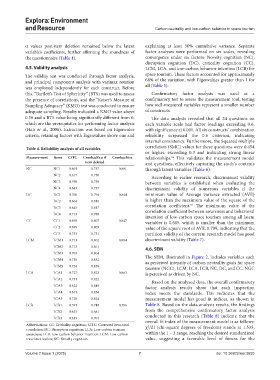
                                                               internal consistency. Furthermore, the Squared multiple
            Table 4. Reliability analysis of all variables     correlation (SMC) values for these questions were 0.454
                                                               or higher, exceeding 0.3 and indicating strong linear
            Measurement  Items  CITC  Cronbach’s α if   Cronbach’s α  relationships.  This validates the measurement model
                                                                          56
                                     item deleted              and questions, effectively capturing the study’s contents
            NC          NC1   0.601     0.757       0.801      through latent variables (Table 6).
                        NC2   0.617     0.750                    According to earlier research, discriminant validity
                        NC3   0.598     0.759                  between variables is established when evaluating the
                        NC4   0.643     0.737                  discriminant validity of numerous variables if the
            DC          DC1   0.700     0.794       0.844      minimum value of Average variance extracted (AVE)
                        DC2   0.664     0.810                  is higher than the maximum value of the square of the
                                                                                  57
                        DC3   0.645     0.817                  correlation coefficient.  The maximum value of the
                                                               correlation coefficient between awareness and behavioral
                        DC4   0.713     0.788
                                                               intention of low-carbon space tourism among all latent
            CC          CC1   0.695     0.807       0.847
                                                               variables is 0.685, which is smaller than the minimum
                        CC2   0.699     0.803                  value of the square root of AVE, 0.709, indicating that the
                        CC3   0.753     0.751                  partition validity of the current research model has good
            LCM         LCM1  0.711     0.862       0.884      discriminant validity (Table 7).
                        LCM2  0.713     0.861
                                                               4.6. SEM
                        LCM3  0.703     0.864
                        LCM4  0.758     0.852                  The SEM, illustrated in Figure 2, includes variables such
                                                               as perceived intensity of carbon neutrality goals for space
                        LCM5  0.724     0.859                  tourism (NGC), LCM, LCA, LCB, NC, DC, and CC. NGC
            LCA         LCA1  0.727     0.823       0.863      is perceived as driven by NC.
                        LCA2  0.731     0.822                    Based on the analyzed data, the overall confirmatory
                        LCA3  0.624     0.849                  factor analysis results show that each inspection
                        LCA4  0.611     0.854                  index meets the standards. This indicates that the
                        LCA5  0.728     0.824                  measurement model has good fit indices, as shown in
            LCB         LCB1  0.591     0.748       0.786      Table 8. Based on the data analysis results, the findings
                        LCB2  0.653     0.681                  from  the  comprehensive  confirmatory  factor  analysis
                        LCB3  0.635     0.701                  conducted in this research (Table  8) indicate that the
            Abbreviations: CC: Criticality cognition; CITC: Corrected item-total   overall fit index of the measurement model is as follows:
                                                               χ /df (chi-square degrees of freedom) stands at 1.535,
                                                                2
            correlation; DC: Disruption cognition; LCA: Low-carbon tourism
            awareness; LCB: Low-carbon behavior intention; LCM: Low-carbon   within the 1 – 3 range, reaching the desired standardized
            travel motivation; NC: Novelty cognition.          value, suggesting a favorable level of fitness for the
            Volume 2 Issue 1 (2025)                         7                                doi: 10.36922/eer.3655

