


Page 113 - EER-2-1
P. 113
Explora: Environment
            and Resource                                           Carbon neutrality and low-carbon behavior in space tourism


            the elderly because of risk perception. Over 80% had a   the mean ± 1.96 standard deviations, whereas 99%
            bachelor’s degree or higher, indicating a high educational   falls within the mean ± 2.58 standard deviations.  In
                                                                                                         53
            level of the respondents. In terms of occupation, slightly   Table  2, the mean values for each behavioral intention
            more than half of the respondents (51%) were students.   indicator are between 5.10 and 5.22, signifying strong
            Geographically, 76.4% of the respondents expressing a   intent from respondents. Regarding skewness and
            strong interest in low-carbon space tourism hailed from   kurtosis, coefficients for the indicators ranged from
            mainland China. Monthly income analysis showed that   −1 to 0, indicating a close-to-normal distribution. The
            45.4% earned RMB 3,000 or less, reflecting the student-  skewness coefficients ranged from −1 to 0, whereas
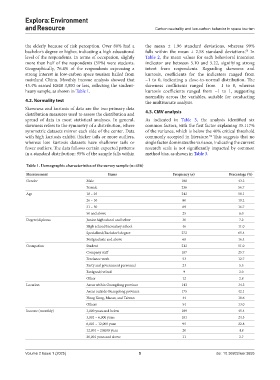
            heavy sample, as shown in Table 1.                 kurtosis coefficients ranged from −1 to 1, suggesting
                                                               normality across the variables, suitable for conducting
            4.2. Normality test                                the multivariate analysis.
            Skewness and kurtosis of data are the two primary data
            distribution measures used to assess the distribution and   4.3. CMV analysis
            spread of data in most statistical analyses. In general,   As indicated in  Table  3, the analysis identified six
            skewness refers to the symmetry of a distribution, where   common factors, with the first factor explaining 35.117%
            symmetric datasets mirror each side of the center. Data   of the variance, which is below the 40% critical threshold
            with high kurtosis exhibit thicker tails or more outliers,   commonly accepted in literature.  This suggests that no
                                                                                          54
            whereas low kurtosis datasets have shallower tails or   single factor dominates the variance, indicating the current
            fewer outliers. The data follows certain expected patterns   research scale is not significantly impacted by common
            in a standard distribution: 95% of the sample falls within   method bias, as shown in Table 3.

            Table 1. Demographic characteristics of the survey sample (n=416)

            Measurement                        Items                       Frequency (n)          Percentage (%)
            Gender                    Male                                    180                     43.3
                                      Female                                  236                     56.7
            Age                       18 – 25                                 242                     58.1
                                      26 – 30                                  80                     19.2
                                      31 – 50                                  69                     16.7
                                      50 and above                             25                      6.0
            Degree/diploma            Junior high school and below             30                      7.2
                                      High school/Secondary school             46                     11.0
                                      Specialized/Bachelor’s degree           272                     65.4
                                      Postgraduate and above                   68                     16.4
            Occupation                Student                                 212                     51.0
                                      Company staff                           107                     25.7
                                      Freelance work                           53                     12.7
                                      Party and government personnel           23                      5.5
                                      Resigned/retired                         9                       2.0
                                      Other                                    12                      2.8
            Location                  Areas within Guangdong province         143                     34.3
                                      Areas outside Guangdong province        175                     42.1
                                      Hong Kong, Macao, and Taiwan             44                     10.6
                                      Others                                   54                     13.0
            Income (monthly)          3,000 yuan and below                    189                     45.4
                                      3,001 – 6,000 yuan                      101                     24.3
                                      6,001 – 12,000 yuan                      95                     22.8
                                      12,001 – 20,000 yuan                     20                      4.8
                                      20,001 yuan and above                    11                      2.7


            Volume 2 Issue 1 (2025)                         5                                doi: 10.36922/eer.3655

