


Page 118 - EER-2-1
P. 118
Explora: Environment
            and Resource                                           Carbon neutrality and low-carbon behavior in space tourism


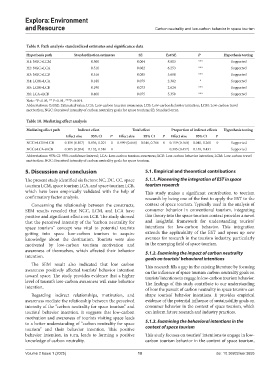
            Table 9. Path analysis standardized estimates and significance data
            Hypothesis path      Standardization estimates  SE          Est/SE       P          Hypothesis testing
            H1: NGC→LCM                 0.560              0.064        8.803        ***           Supported
            H2: NGC→LCA                 0.510              0.082        6.253        ***           Supported
            H3: NGC→LCB                 0.316              0.085        3.698        ***           Supported
            H4: LCM→LCA                 0.188              0.079        2.382         *            Supported
            H5: LCM→LCB                 0.190              0.073        2.624        ***           Supported
            H6: LCA→LCB                 0.400              0.075        5.350        ***           Supported
            Note: *P<0.05, ** P<0.01, ***P<0.001.
            Abbreviations: Est/SE: Estimated value; LCA: Low-carbon tourism awareness; LCB: Low-carbon behavior intention; LCM: Low-carbon travel
            motivation; NGC: Perceived intensity of carbon neutrality goals for space tourism; SE: Standard error.

            Table 10. Mediating effect analysis

            Mediating effect path  Indirect effect       Total effect     Proportion of indirect effects  Hypothesis testing
                             Effect size  95% CI  P  Effect size  95% CI  P  Effect size  95% CI  P
            NGC→LCM→LCB      0.159 (0.107)  0.036, 0.201  0  0.999 (0.668)  0.546, 0.766  0  0.159 (0.160)  0.040, 0.260  0  Supported
            NGC→LCA→LCB      0.305 (0.204)  0.132, 0.316  0              0.305 (0.457)  0.158, 0.431  Supported
            Abbreviations: 95% CI: 95% confidence interval; LCA: Low-carbon tourism awareness; LCB: Low-carbon behavior intention; LCM: Low-carbon travel
            motivation; NGC: Perceived intensity of carbon neutrality goals for space tourism.

            5. Discussion and conclusion                       5.1. Empirical and theoretical contributions
            The present study identified six factors: NC, DC, CC, space   5.1.1. Pioneering the integration of EST in space
            tourism LCM, space tourism LCA, and space tourism LCB,   tourism research
            which  have been empirically validated with the  help of   This study makes a significant contribution to tourism
            confirmatory factor analysis.                      research by being one of the first to apply the EST to the
              Concerning the relationship between the constructs,   context of space tourism. Typically used in the analysis of
            SEM results revealed that NGC, LCM, and LCA have   consumer behavior in conventional tourism, integrating
            positive and significant effects on LCB. The study showed   this theory into the space tourism context provides a novel
            that the perceived intensity of the “carbon neutrality for   and insightful framework for understanding tourists’
            space tourism” concept was vital to potential tourists   intentions for low-carbon behavior. This integration
            getting into space low-carbon tourism to acquire   extends  the  applicability  of  the  EST  and  opens  up  new
            knowledge  about  the  destination.  Tourists  were  also   avenues for research in the tourism industry, particularly
            motivated by low-carbon tourism motivation and     in the emerging field of space tourism.
            awareness of themselves, which affected their behavior   5.1.2. Examining the impact of carbon neutrality
            intention.                                         goals on tourists’ behavioral intentions
              The SEM result also indicated that low carbon    This research fills a gap in the existing literature by focusing
            awareness positively affected tourists’ behavior intention   on the influence of space tourism carbon neutrality goals on
            toward space. The study provides evidence that a higher   tourists’ intentions to engage in low-carbon tourism behavior.
            level of tourist’s low-carbon awareness will raise behavior   The findings of this study contribute to our understanding
            intention.                                         of how the pursuit of carbon neutrality in space tourism can
              Regarding indirect relationships, motivation, and   shape tourists’ behavior intentions. It provides empirical
            awareness mediate the relationship between the perceived   evidence of the potential influence of sustainability goals on
            intensity of the “carbon neutrality for space tourism” and   consumer behavior in the context of space tourism, which
            tourists’ behavior intention. It suggests that low-carbon   can inform future research and industry practices.
            motivation and awareness of tourists visiting space leads
            to a better understanding of “carbon neutrality for space   5.1.3. Examining the behavioral intentions in the
            tourism” and their behavior intention. This positive   context of space tourism
            behavior intention, in turn, leads to forming a positive   This study focuses on tourists’ intentions to engage in low-
            knowledge of carbon neutrality.                    carbon tourism behavior in the context of space tourism,

            Volume 2 Issue 1 (2025)                         10                               doi: 10.36922/eer.3655

