


Page 181 - EJMO-9-3
P. 181
Eurasian Journal of
            Medicine and Oncology                                                  Research on DSY in treating gastritis


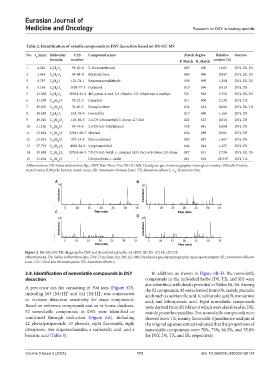
            Table 2. Identification of volatile compounds in DSY decoction based on HS‑GC‑MS
            No. t (min) Molecular   CAS   Compound name                        Match degree  Relative   Sources
                R
                      formula  number                                        P. Match R. Match  content (%)
            1    4.240  C H O 2  98-00-0  2-Furanmethanol                      803    830     1.065  DSY, SR, DS
                       5
                         6
            2    5.444  C H O   96-48-0  Butyrolactone                         860    966     0.947  DSY, SR, DS
                       4  6  2
            3    8.787  C H O  122-78-1  Benzeneacetaldehyde                   929    959     1.294  DSY, SR, DS
                       8  8
            4    9.144  C H O  3658-77-3 Furaneol                              810    836     0.410  DSY, DS
                       6  8  3
            5   11.568 C H O 4  28564-83-2 4H-pyran-4-one, 2,3-dihydro-3,5-dihydroxy-6-methyl-  921  926  5.750  DSY, SR, DS
                         8
                       6
            6   11.659 C H O    76-22-2  Camphor                               811    906     2.138  DSY, TX
                       10
                         16
            7   15.635 C H O    76-49-3  Bornyl acetate                        834    834     0.666  DSY, SR, TX
                       12  20  2
            8   18.588 C H O   621-59-0  Isovanillin                           817    860     1.166  DSY, DS
                       8  8  3
            9   19.016 C H O   126-86-3  2,4,7,9-Tetramethyl-5-decyn-4,7-diol  822    825     0.818  DSY, DS
                       14  26  2
            10  21.126 C H O    96-76-4  2,4-Di-tert-butylphenol               938    941     4.684  DSY, DS
                       14  22
            11  23.664 C H O  23811-08-7 Hinesol                               854    889     0.565  DSY, DS
                       15
                         26
            12  23.893 C H O   473-15-4  Beta-eudesmol                         885    887     1.467  DSY, DS
                         26
                       15
            13  27.793 C H O   4666-84-6 Cryptomeridiol                        844    844     1.472  DSY, DS
                       15  28  2
            14  30.888 C H O  82304-66-3 7,9-Di-tert-butyl-1- oxaspiro (4,5) deca-6,9-diene-2,8-dione  887  891  2.734  DSY, SR, DS
                       17  24  3
            15  31.164 C H O      /    Diepicedrene-1-oxide                    801    810     45.539  DSY, TX
                       15  24
            Abbreviations: DS: Salvia miltiorrhiza Bge.; DSY: Dan-Shen-Yin; HS-GC-MS: Headspace gas chromatography–mass spectrometry; P.Match: Positive
            match score; R.Match: Reverse match score; SR: Amomum villosum Lour.; TX: Santalum album L.; t : Retention time.
                                                                           R
                        A                                  B
                        C
                                                           D


            Figure 2. HS-GC-MS TIC diagram for DSY and its individual herbs. (A) DSY. (B) DS. (C) SR. (D) TX
            Abbreviations: DS: Salvia miltiorrhiza Bge.; DSY: Dan-Shen-Yin; HS-GC-MS: Headspace gas chromatography–mass spectrometry; SR: Amomum villosum
            Lour.; TIC: Total ion chromatogram; TX: Santalum album L.

            3.4. Identification of nonvolatile compounds in DSY   In addition, as shown in  Figure  6B–D, the nonvolatile
            decoction                                          compounds in the individual herbs (DS, TX, and SR) were
                                                               also identified, with details provided in Tables S6–S8. Among
            A precursor ion list consisting of 304 ions (Figure  5D),   the 52 compounds, 42 were derived from DS, mainly phenolic
            including 163 [M+H]  and 141 [M-H] , was constructed   acids such as salvianolic acid A, salvianolic acid B, rosmarinic
                              +
                                            -
            to increase detection sensitivity for trace compounds.   acid, and lithospermic acid. Eight nonvolatile compounds
            Based on reference compounds and an in-house database,   were derived from SR (three of which were also found in DS),
            52  nonvolatile  compounds  in  DSY  were  identified  or   mainly proanthocyanidins. Five nonvolatile compounds were
            confirmed through deduction (Figure  6A), including   derived from TX, mainly flavonoids. Quantitative analysis of
            22 phenylpropanoids, 10 phenols, eight flavonoids, eight   the original aqueous extract indicated that the proportions of
            diterpenes, two oligosaccharides, a carboxylic acid, and a   nonvolatile components were 70%, 73%, 66.3%, and 55.8%
            benzoic acid (Table 3).                            for DSY, DS, TX, and SR, respectively.


            Volume 9 Issue 3 (2025)                        173                         doi: 10.36922/EJMO025160124

