


Page 281 - EJMO-9-3
P. 281
Eurasian Journal of
            Medicine and Oncology                                         WGCNA and LASSO for osteoporosis biomarkers


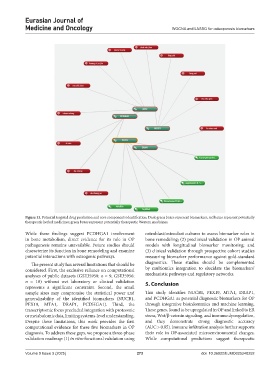
            Figure 11. Potential targeted drug prediction and core components identification. Dark green boxes represent biomarkers; red boxes represent potentially
            therapeutic herbal medicines; green boxes represent potentially therapeutic Western medicines.

            While these findings suggest PCDHGA1 involvement   osteoblast/osteoclast cultures to assess biomarker roles in
            in  bone  metabolism,  direct  evidence  for  its  role  in  OP   bone remodeling; (2) preclinical validation in OP animal
            pathogenesis remains unavailable. Future studies should   models  with  longitudinal  biomarker  monitoring;  and
            characterize its function in bone remodeling and examine   (3) clinical validation through prospective cohort studies
            potential interactions with osteogenic pathways.   measuring biomarker performance against gold-standard
              The present study has several limitations that should be   diagnostics. These studies should be complemented
            considered. First, the exclusive reliance on computational   by multiomics  integration to  elucidate  the biomarkers’
            analyses of public datasets (GSE35958: n = 9; GSE35956:   mechanistic pathways and regulatory networks.
            n = 10) without wet laboratory or clinical validation   5. Conclusion
            represents a significant constraint. Second, the small
            sample  sizes  may  compromise  the  statistical  power  and   This study identifies NUCB1, PEX19, MTA1, DRAP1,
            generalizability of the identified biomarkers (NUCB1,   and PCDHGA1 as potential diagnostic biomarkers for OP
            PEX19, MTA1, DRAP1, PCDHGA1). Third, the           through integrative bioinformatics and machine learning.
            transcriptomic focus precluded integration with proteomic   These genes, found to be upregulated in OP and linked to ER
            or metabolomic data, limiting systems-level understanding.   stress, Wnt/β-catenin signaling, and immune dysregulation,
            Despite these limitations, this work provides the first   and they demonstrate strong diagnostic accuracy
            computational evidence for these five biomarkers in OP   (AUC > 0.85). Immune infiltration analysis further supports
            diagnosis. To address these gaps, we propose a three-phase   their role in OP-associated microenvironmental changes.
            validation roadmap: (1) in vitro functional validation using   While computational predictions suggest therapeutic


            Volume 9 Issue 3 (2025)                        273                         doi: 10.36922/EJMO025240252

