


Page 113 - ESAM-1-2
P. 113
Engineering Science in
            Additive Manufacturing                                           HIP temperature effects on LPBF Hastelloy X


                         (A )                    (B )                    (C )
                          1                        1                       1


                         (A )                    (B )                    (C )
                          2
                                                   2
                                                                           2


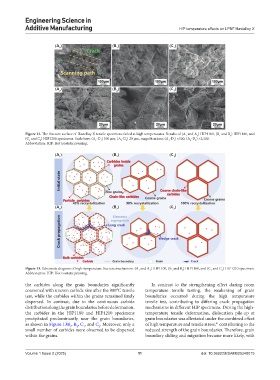
            Figure 12. The fracture surface of Hastelloy X tensile specimens failed at high temperatures. Results of (A  and A ) HIP1100, (B  and B ) HIP1180, and
                                                                                1
                                                                                              1
                                                                                                   2
                                                                                     2
            (C  and C ) HIP1210 specimens. Scale bars: (A -D ) 100 μm; (A -D ) 20 μm, magnifications: (A -D ) ×500; (A -D ) ×2,500.
             1
                  2
                                          1
                                            1
                                                                                  2
                                                                                    2
                                                                           1
                                                                         1
                                                    2
                                                       2
            Abbreviation: HIP: Hot isostatic pressing.
                         (A )                    (B )                    (C )
                          1                        1                       1
                         (A )                    (B )                    (C )
                                                   2
                                                                           2
                          2


            Figure 13. Schematic diagram of high-temperature fracture mechanism. (A  and A ) HIP1100, (B  and B ) HIP1180, and (C  and C ) HIP1210 specimen.
                                                                 2
                                                                              2
                                                            1
                                                                          1
                                                                                           1
                                                                                               2
            Abbreviation: HIP: Hot isostatic pressing.
            the carbides along the grain boundaries significantly   In contrast to the strengthening effect during room
            coarsened with uneven carbide size after the 900°C tensile   temperature tensile testing, the weakening of grain
            test, while the carbides within the grains remained finely   boundaries occurred during the high temperature
            dispersed. In contrast, due to the continuous carbide   tensile test, contributing to differing crack propagation
            distribution along the grain boundaries before deformation,   mechanisms in different HIP specimens. During the high-
            the carbides in the HIP1180 and HIP1210  specimens   temperature tensile deformation, dislocation pile-up at
            precipitated predominantly near the grain boundaries,   grain boundaries was alleviated under the combined effect
            as shown in Figure 13B , B , C , and C . Moreover, only a   of high temperature and tensile stress,  contributing to the
                                                                                             41
                                           2
                                  2
                               1
                                     1
            small number of carbides were observed to be dispersed   reduced strength of the grain boundaries. Therefore, grain
            within the grains.                                 boundary sliding and migration became more likely, with
            Volume 1 Issue 2 (2025)                         11                         doi: 10.36922/ESAM025240015

