


Page 109 - ESAM-1-2
P. 109
Engineering Science in
            Additive Manufacturing                                           HIP temperature effects on LPBF Hastelloy X


             (A )                    (A )                    (A )                    (A )
              1                        2                       3                       1


                                                                                      (B
             (B )                    (B )                    (B )                      4
              1                        2                       3


                                                                                      (C )
             (C )                    (C )                    (C )                       4
              1                        2                       3


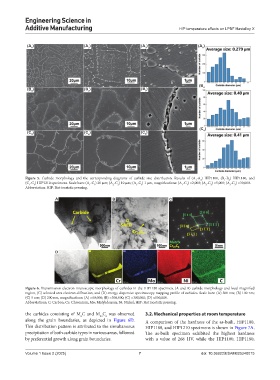
            Figure  5. Carbide morphology and the corresponding  diagrams of carbide size distribution. Results of (A -A ) HIP1100, (B -B ) HIP1180, and
                                                                                    1
                                                                                                1
                                                                                                  4
                                                                                      4
            (C -C ) HIP1210 specimens. Scale bars: (A -C ) 20 μm; (A -C ) 10 μm; (A -C ) 1 μm, magnifications: (A -C ) ×2,000; (A -C ) ×5,000; (A -C ) ×30,000.
                                                           3
                                                             3
                                                   2
                                         1
                                                 2
                                                                                           2
                                                                                1
                                                                                         2
                                                                                                     3
                                                                                                   3
                                                                              1
             1
               4
                                       1
            Abbreviation: HIP: Hot isostatic pressing.
                         A                       B                       C
                         D


            Figure 6. Transmission electron microscopic morphology of carbides in the HIP1180 specimen. (A and B) carbide morphology and local magnified
            region, (C) selected area electron diffraction, and (D) energy dispersive spectroscopy mapping profile of carbides. Scale bars: (A) 500 nm; (B) 100 nm;
            (C) 5 nm; (D) 200 nm, magnifications: (A) ×60,000; (B) ×300,000; (C) ×300,000; (D) ×150,000.
            Abbreviations: C: Carbon; Cr: Chromium; Mo: Molybdenum; Ni: Nickel; HIP: Hot isostatic pressing.
            the carbides consisting of M C and M C  was observed   3.2. Mechanical properties at room temperature
                                            23
                                   6
                                              6
            along the grain boundaries, as depicted in  Figure  6D.   A comparison of the hardness of the as-built, HIP1100,
            This distribution pattern is attributed to the simultaneous   HIP1180, and HIP1210 specimens is shown in Figure 7A.
            precipitation of both carbide types in various areas, followed   The as-built specimen exhibited the highest hardness
            by preferential growth along grain boundaries.     with a value of 268 HV, while the HIP1100, HIP1180,

            Volume 1 Issue 2 (2025)                         7                          doi: 10.36922/ESAM025240015

