


Page 107 - ESAM-1-2
P. 107
Engineering Science in
            Additive Manufacturing                                           HIP temperature effects on LPBF Hastelloy X


                         (A )                         (A )                     (A )
                          1                             2                       3


                                                                               (B )
                         (B )                         (B )                      3
                          1
                                                        2


                                                                               (C )
                         (C )                         (C )                      3
                          1
                                                        2


                                                                               (D )
                         (D )                         (D )                      3
                          1                             2


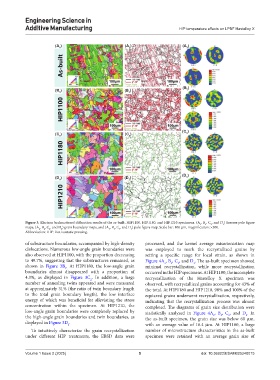
            Figure 3. Electron backscattered diffraction results of the as-built, HIP1100, HIP1180, and HIP1210 specimens. (A , B , C , and D ) Inverse pole figure
                                                                                                1
                                                                                           1
                                                                                        1
                                                                                      1
            maps, (A , B , C , and D ) grain boundary maps, and (A , B , C , and D ) pole figure map. Scale bar: 100 μm, magnification: ×500.
                                               3
                           2
                                                         3
                                                    3
                                                 3
                      2
                    2
                  2
            Abbreviation: HIP: Hot isostatic pressing.
            of substructure boundaries, accompanied by high-density   processed, and the kernel average misorientation map
            dislocations. Numerous low-angle grain boundaries were   was employed to mark the recrystallized grains by
            also observed at HIP1100, with the proportion decreasing   setting a specific range for local strain, as shown in
            to 49.7%, suggesting that the substructures remained, as   Figure 4A , B , C , and D . The as-built specimen showed
                                                                          1
                                                                                   1
                                                                             1
                                                                       1
            shown in  Figure  3B . At HIP1180, the low-angle grain   minimal recrystallization, while more recrystallization
                             2
            boundaries almost disappeared with a proportion of   occurred in the HIP specimens. At HIP1100, the incomplete
            4.3%, as displayed in  Figure  3C . In addition, a large   recrystallization of the Hastelloy X specimen was
                                       2
            number of annealing twins appeared and were measured   observed, with recrystallized grains accounting for 43% of
            at approximately 31% (the ratio of twin boundary length   the total. At HIP1180 and HIP1210, 98% and 100% of the
            to the total grain boundary length), the low interface   equiaxed grains underwent recrystallization, respectively,
            energy of which was beneficial for alleviating the stress   indicating that the recrystallization process was almost
            concentration within the specimen. At HIP1210, the   completed. The  diagrams of grain size distribution were
            low-angle grain boundaries were completely replaced by   statistically analyzed in  Figure  4A ,  B ,  C , and  D . In
                                                                                            2
                                                                                                  2
                                                                                               2
                                                                                                          2
            the high-angle grain boundaries and twin boundaries, as   the as-built specimen, the  grain size  was below  60  μm,
            displayed in Figure 3D .                           with an average value of 16.4  μm. At HIP1100, a large
                              2
              To intuitively characterize the grain recrystallization   number of microstructure characteristics in the as-built
            under different HIP treatments, the EBSD data were   specimen were retained with an average grain size of
            Volume 1 Issue 2 (2025)                         5                          doi: 10.36922/ESAM025240015

