


Page 108 - ESAM-1-2
P. 108
Engineering Science in
            Additive Manufacturing                                           HIP temperature effects on LPBF Hastelloy X


             (A )                    (B )                    (C )                    (D )
              1                        1                       1                      1


             (A )                   (B )                     (C )                    (D )
              2                       2                        2                       2


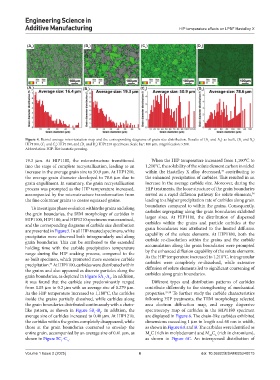
            Figure 4. Kernel average misorientation map and the corresponding diagrams of grain size distribution. Results of (A  and A ) as built, (B  and B )
                                                                                                            2
                                                                                                       1
                                                                                          1
                                                                                               2
            HIP1100, (C  and C ) HIP1180, and (D  and D ) HIP1210 specimens. Scale bar: 100 μm, magnification: ×500.
                                     1
                                          2
                    1
                         2
            Abbreviation: HIP: Hot isostatic pressing.
            19.3  μm.  At  HIP1180,  the  microstructure  transitioned   When the HIP temperature increased from 1,100°C to
            into the stage of complete recrystallization, leading to an   1,210°C, the solubility of the solute element carbon in nickel
            increase in the average grain size to 50.9 μm. At HIP1210,   within the Hastelloy X alloy decreased,  contributing to
                                                                                               35
            the average grain diameter developed to 78.6 μm due to   the enhanced precipitation of carbides. This resulted in an
            grain engulfment. In summary, the grain recrystallization   increase in the average carbide size. Moreover, during the
            process was prompted as the HIP temperature increased,   HIP treatments, the loose structure of the grain boundaries
            accompanied by the microstructure transformation from   served as a rapid diffusion pathway for solute elements,
                                                                                                            36
            the fine columnar grains to coarse equiaxed grains.  leading to a higher precipitation rate of carbides along grain
              To investigate phase evolution within the grains and along   boundaries compared to within the grains. Consequently,
            the grain boundaries, the SEM morphology of carbides in   carbides segregating along the grain boundaries exhibited
            HIP1100, HIP1180, and HIP1210 specimens was examined,   larger sizes. At HIP1100, the distribution of dispersed
            and the corresponding diagrams of carbide size distribution   carbides within the grains and particle carbides at the
            are presented in Figure 5. In all HIP-treated specimens, white   grain boundaries was attributed to the limited diffusion
            precipitates were observed both intragranularly and along   capability of the solute elements. At HIP1180, both the
            grain boundaries. This can be attributed to the extended   carbide re-dissolution within the grains and the carbide
            holding time with the  carbide precipitation temperature   accumulation along the grain boundaries were prompted
            range during the HIP soaking process, compared to the   by the enhanced diffusion capability of the solute elements.
            as-built specimen, which promoted more extensive carbide   As the HIP temperature increased to 1,210°C, intragranular
            precipitation.  At HIP1100, carbides were distributed within   carbides were completely re-dissolved, while extensive
                      34
            the grains and also appeared as discrete particles along the   diffusion of solute elements led to significant coarsening of
            grain boundaries, as depicted in Figure 5A -A . In addition,   carbides along grain boundaries.
                                             1
                                                4
            it was found that the carbide size predominantly ranged   Different types and distribution patterns of carbides
            from 0.05 μm to 0.2 μm with an average size of 0.279 μm.   contribute differently to the strengthening of mechanical
            As the HIP temperature increased to 1,180°C, the carbides   properties. 37,38  To further study the carbide characteristics
            inside the grains partially dissolved, while carbides along   following HIP treatments, the TEM morphology, selected
            the grain boundaries distributed continuously with a chain-  area electron diffraction map, and energy dispersive
            like pattern, as shown in  Figure  5B -B . In addition, the   spectroscopy map of carbides in the HIP1180  specimen
                                            4
                                         1
            average size of carbides increased to 0.40 μm. At HIP1210,   are displayed in Figure 6. The chain-like carbides exhibited
            the carbides within the grains completely disappeared, while   dimensions exceeding 1 μm in length and 60 nm in width,
            those at the grain boundaries coarsened to envelop the   as shown in Figure 6A and B. The carbides were identified as
            entire grain, accompanied by an average size of 0.41 μm, as   M C (rich in molybdenum) and M C  (rich in chromium),
                                                                                             6
                                                                 6
                                                                                          23
            shown in Figure 5C -C .                            as shown in  Figure  6C. An interspersed distribution of
                           1
                              4
            Volume 1 Issue 2 (2025)                         6                          doi: 10.36922/ESAM025240015

