


Page 106 - ESAM-1-2
P. 106
Engineering Science in
            Additive Manufacturing                                           HIP temperature effects on LPBF Hastelloy X


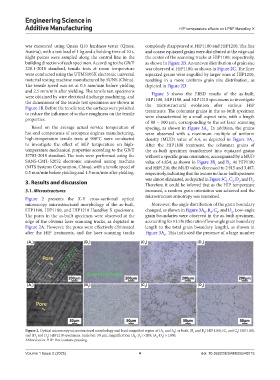
            was measured using Qness Q10 hardness  tester (Qness,   completely disappeared at HIP1180 and HIP1210. The fine
            Austria), with a test load of 1 kg and a holding time of 10 s.   and coarse equiaxed grains were distributed at the edge and
            Eight points were sampled along the central line in the   the center of the scanning tracks at HIP1100, respectively,
            building direction of each specimen. According to the GB/T   as shown in Figure 2B. An uneven distribution of grain size
            228.1-2010 standard, tensile tests at room temperature   was observed at HIP1180, as shown in Figure 2C. The finer
            were conducted using the UTM5105X electronic universal   equiaxed grains were engulfed by larger ones at HIP1210,
            material testing machine manufactured by SUNS (China).   resulting in a more uniform grain size distribution, as
            The tensile speed was set at 0.5 mm/min before yielding   depicted in Figure 2D.
            and 2.5 mm/min after yielding. The tensile test specimens   Figure  3 shows the EBSD results of the as-built,
            were obtained by wire electrical discharge machining, and   HIP1100, HIP1180, and HIP1210 specimens to investigate
            the dimensions of the tensile test specimens are shown in   the microstructural evolution after various HIP
            Figure 1B. Before the tensile test, the surfaces were polished   treatments. The columnar grains in the as-built specimen
            to reduce the influence of surface roughness on the tensile   were characterized by a small aspect ratio, with a length
            properties.
                                                               of 80 – 100 μm, corresponding to the set laser scanning
              Based on the average actual service temperature of   spacing, as shown in Figure 3A . In addition, the grains
                                                                                         1
            hot-end components of aerospace engines manufacturing,   were observed with a maximum multiple of uniform
            high-temperature tensile  tests at 900°C  were conducted   density (MUD) value of 6.4, as depicted in  Figure  3A .
                                                                                                            3
            to investigate the effect of  HIP temperature on  high-  After  the  HIP1100 treatment, the columnar grains of
            temperature mechanical properties according to the GB/T   the as-built specimen  transformed into  equiaxed grains
            37783-2019 standard. The tests were performed using the   without a specific grain orientation, accompanied by a MUD
            SANS-CMT-52052 electronic universal testing machine   value of 4.834, as shown in Figure 3B  and B . At HIP1180
                                                                                            1
                                                                                                  3
            (MTS Systems Corporation, China), with a tensile speed of   and HIP1210, the MUD values decreased to 2.915 and 3.487,
            0.5 mm/min before yielding and 1.5 mm/min after yielding.  respectively, indicating that the texture in the as-built specimen
                                                               was almost eliminated, as depicted in Figure 3C , C , D , and D .
            3. Results and discussion                          Therefore, it could be inferred that as the HIP temperature
                                                                                                      1
                                                                                                 1
                                                                                                    3
                                                                                                            3
            3.1. Microstructures                               increased, a random grain orientation was achieved and the
                                                               microstructure anisotropy was restrained.
            Figure  2 presents the X-Y cross-sectional optical
            microscopy microstructural morphology of the as-built,   Moreover, the angle distribution of the grain boundary
            HIP1100, HIP1180, and HIP1210 Hastelloy X specimens.   changed, as shown in Figure 3A , B , C , and D . Low-angle
                                                                                                   2
                                                                                             2
                                                                                        2
                                                                                          2
            The pores in the as-built specimen were observed at the   grain boundaries were observed in the as-built specimen,
            edge of the obvious laser scanning tracks, as depicted in   accounting for 51.5% (the ratio of low-angle grain boundary
            Figure 2A. However, the pores were effectively eliminated   length to the total grain boundary length), as shown in
            after the HIP treatments, and the laser scanning tracks   Figure 3A . This indicated the presence of a large number
                                                                       2
             (A )                    (B )                    (C )                    (D )
              1                       1                        1                       1


             (A )                    (B )                    (C )                    (D )
              2                       2                        2                       2


            Figure 2. Optical microscopy microstructural morphology and local magnified region of (A  and A ) as built, (B  and B ) HIP1100, (C  and C ) HIP1180,
                                                                                        2
                                                                                                 1
                                                                                                      2
                                                                      1
                                                                                   1
                                                                           2
            and (D  and D ) HIP1210 specimens. Scale bar: 50 μm, magnification: (A -D ) ×200; (A -D ) ×1,000.
                     2
                1
                                                           1
                                                                      2
                                                                    2
                                                             1
            Abbreviation: HIP: Hot isostatic pressing.
            Volume 1 Issue 2 (2025)                         4                          doi: 10.36922/ESAM025240015

