


Page 110 - ESAM-1-2
P. 110
Engineering Science in
            Additive Manufacturing                                           HIP temperature effects on LPBF Hastelloy X


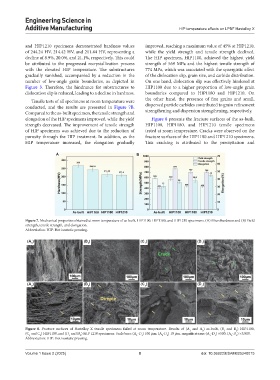
            and  HIP1210  specimens  demonstrated  hardness  values   improved, reaching a maximum value of 45% at HIP1210,
            of 244.24 HV, 214.42 HV, and 211.44 HV, representing a   while the yield strength and tensile strength declined.
            decline of 8.9%, 20.0%, and 21.1%, respectively. This could   The HIP specimen, HIP1100, achieved the highest yield
            be attributed to the progressed recrystallization process   strength  of  569  MPa  and  the  highest  tensile  strength  of
            with the elevated HIP temperature. The substructures   774 MPa, which was associated with the synergistic effect
            gradually vanished, accompanied by a reduction in the   of the dislocation slip, grain size, and carbide distribution.
            number of low-angle grain boundaries, as depicted in   On one hand, dislocation slip was effectively hindered at
            Figure  3. Therefore, the hindrance for substructures to   HIP1100 due to a higher proportion of low-angle grain
            dislocation slip is reduced, leading to a decline in hardness.  boundaries compared to HIP1180 and HIP1210. On
                                                               the other hand, the presence of fine grains and small,
              Tensile tests of all specimens at room temperature were
            conducted, and the results are presented in  Figure  7B.   dispersed particle carbides contributed to grain refinement
            Compared to the as-built specimen, the tensile strength and   strengthening and dispersion strengthening, respectively.
            elongation of the HIP specimens improved, while the yield   Figure 8 presents the fracture surfaces of the as-built,
            strength decreased. The improvement of tensile strength   HIP1100, HIP1180, and HIP1210 tensile specimens
            of HIP specimens was achieved due to the reduction of   tested at room temperature. Cracks were observed on the
            porosity through the HIP treatment. In addition, as the   fracture surfaces of the HIP1180 and HIP1210 specimens.
            HIP temperature increased, the elongation gradually   This cracking is attributed to the precipitation and

                         A                                 B


            Figure 7. Mechanical properties obtained at room temperature of as-built, HIP1100, HIP1180, and HIP1210 specimens. (A) Microhardness and (B) Yield
            strength, tensile strength, and elongation.
            Abbreviation: HIP: Hot isostatic pressing.

             (A )                    (B )                    (C )                    (D )
              1                       1                        1                       1


             (A )                    (B )                    (C )                    (D )
              2                       2                        2                       2


            Figure  8. Fracture surfaces of Hastelloy X tensile specimens failed at room temperature. Results of (A  and A ) as-built, (B  and B ) HIP1100,
                                                                                                1
                                                                                                     2
                                                                                  1
                                                                                       2
            (C  and C ) HIP1180, and (D  and D ) HIP 1210 specimens. Scale bars: (A -D ) 100 μm; (A -D ) 10 μm, magnifications: (A -D ) ×500; (A -D ) ×5,000.
                                                                                                      2
             1
                                                                                          1
                                                                                                   2
                                                                                            1
                                                                        2
                                                           1
                                   2
                              1
                                                                      2
                  2
                                                             1
            Abbreviation: HIP: Hot isostatic pressing.
            Volume 1 Issue 2 (2025)                         8                          doi: 10.36922/ESAM025240015

