


Page 112 - ESAM-1-2
P. 112
Engineering Science in
            Additive Manufacturing                                           HIP temperature effects on LPBF Hastelloy X


            high-temperature tensile test, cracks were observed in   characteristics of laser scanning morphology were retained
            areas enriched with carbides along the grain boundaries   on the fracture surface at HIP1100, accompanied by obvious
            of all specimens. The average carbide size of the   cracks, as shown in Figure 12A  and A . The fracture surface
                                                                                       1
                                                                                            2
            HIP1100 specimen increased from 0.279 μm to 0.416 μm,   of HIP1180 exhibited a pronounced massive pattern
            as  shown  in  Figure  10A -A .  Moreover,  the  carbide   morphology, which corresponded to the brittleness of the
                                  1
                                     4
            distribution along the grain boundaries transformed from   grain boundaries, as shown in Figure 12B  and B . Compared
                                                                                                    2
                                                                                              1
            particle distribution to bulk distribution. However, the   to  the  HIP1100  and  HIP1180  specimens,  this  massive
            average carbide size at both HIP1180 and HIP1210 showed   feature was even more prominent in the HIP1210 specimen,
            minimal changes compared to that of room temperature,   demonstrating a typical characteristic of intergranular
            as shown in  Figure  10B -B  and  C -C . Furthermore,   fracture, as presented in Figure 12C  and C .
                                 1
                                    4
                                           1
                                             4
            carbides were observed within the grains in the HIP1180                        1    2
            and HIP1210  specimens. However, the carbides at the   Based on the above analysis, the high-temperature
            grain boundaries exhibited a chain-like distribution, with   fracture mechanisms of the HIP specimens are presented
            a higher concentration on grain boundaries compared to   in  Figure  13. During the 900°C tensile test, carbides
            within the grains.                                 continued to precipitate and coarsen in the HIP specimens.
                                                               Due to the enhanced diffusion capability of solute elements
              Figure  11  illustrates  the  microstructural  morphology   in the high-temperature tensile test,  these elements
                                                                                              37
            and the local magnified region of the deformation region   exhibited a propensity to segregate into regions of high-
            failed at the 900°C tensile test of HIP specimens. Long   density dislocations and grain boundaries, promoting
            cracks penetrating the tensile specimen were observed in   carbide precipitation and coarsening in those areas.
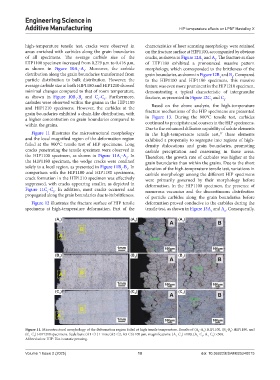
            the  HIP1100  specimen, as  shown in  Figure  11A -A . In   Therefore, the growth rate of carbides was higher at the
                                                       3
                                                    1
            the HIP1180  specimen, the wedge cracks were confined   grain boundaries than within the grains. Due to the short
            solely to a local region, as presented in Figure 11B -B . In   duration of the high-temperature tensile test, variations in
                                                       3
                                                    1
            comparison with the HIP1100 and HIP1180  specimens,   carbide morphology among the different HIP specimens
            crack formation in the HIP1210 specimen was effectively   were primarily governed by their morphology before
            suppressed, with cracks appearing smaller, as depicted in   deformation. In the HIP1100  specimen, the presence of
            Figure  11C -C . In addition, most cracks occurred and   numerous vacancies and the discontinuous distribution
                        3
                     1
            propagated along the grain boundaries due to its brittleness.  of particle carbides along the grain boundaries before
              Figure 12 illustrates the fracture surface of HIP tensile   deformation proved conducive to the carbides during the
            specimens  at high-temperature deformation. Part  of the   tensile test, as shown in Figure 13A  and A . Consequently,
                                                                                                2
                                                                                           1
                         (A )                            (A )                (A )
                                                          2
                                                                               3
                          1

                         (B )                            (B )                (B )
                          1                               2                    3


                         (C )                            (C )                (C )
                          1                               2                    3


            Figure 11. Microstructural morphology of the deformation region failed at high tensile temperature. Results of (A -A ) HIP1100, (B -B ) HIP1180, and
                                                                                        3
                                                                                                   3
                                                                                                 1
                                                                                     1
            (C -C ) HIP1210 specimens. Scale bars: (A1-C1) 1 mm; (A2-C2, A3-C3) 100 μm, magnifications: (A -C ) ×100; (A -C , A -C ) ×500.
                                                                            1
                                                                              1
             1
               3
                                                                                     2
                                                                                         3
                                                                                           3
                                                                                       2
            Abbreviation: HIP: Hot isostatic pressing.
            Volume 1 Issue 2 (2025)                         10                         doi: 10.36922/ESAM025240015

