


Page 111 - ESAM-1-2
P. 111
Engineering Science in
            Additive Manufacturing                                           HIP temperature effects on LPBF Hastelloy X


            coarsening of carbides along the grain boundaries, which   failure mode at room temperature was characteristic of
            eventually envelop the grains and increase the brittleness   ductile fracture.
            of the grain boundaries, as shown in  Figure  5. During
            subsequent plastic deformation, the secondary cracks were   3.3. Mechanical properties at high temperature
            induced through crystal fractures.  Furthermore, higher   To evaluate high-temperature mechanical properties, the
                                        39
            magnification images revealed numerous dimples in the   tensile results of HIP specimens at 900°C are presented in
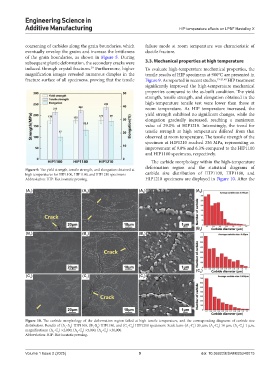
            fracture surface of all specimens, proving that the tensile   Figure 9. As reported in recent studies, 19-21,40  HIP treatment
                                                               significantly improved the high-temperature mechanical
                                                               properties compared to the as-built condition. The yield
                                                               strength, tensile strength, and elongation obtained in the
                                                               high-temperature tensile test were lower than those at
                                                               room temperature. As HIP temperature increased, the
                                                               yield strength exhibited no significant changes, while the
                                                               elongation gradually increased, reaching a maximum
                                                               value of 29.0% at HIP1210. Interestingly, the trend for
                                                               tensile strength at high temperature differed from that
                                                               observed at room temperature. The tensile strength of the
                                                               specimen at HIP1210 reached 236 MPa, representing an
                                                               improvement of 9.8% and 6.3% compared to the HIP1100
                                                               and HIP1180 specimens, respectively.
                                                                 The carbide morphology within the high-temperature
                                                               deformation region and the statistical  diagrams of
            Figure 9. The yield strength, tensile strength, and elongation obtained at
            high temperatures for HIP1100, HIP1180, and HIP1210 specimens  carbide size distribution of HIP1100, HIP1180, and
            Abbreviation: HIP: Hot isostatic pressing.         HIP1210 specimens are displayed in Figure 10. After the

            (A )                    (A )                    (A )                    (A )
                                      2
                                                              3
              1
                                                                                      4


                                                                                    (B )
                                                                                      4
            (B )                    (B )                    (B )
              1
                                                              3
                                      2


                                                                                    (C )
                                                                                      4
            (C )                    (C )                    (C )
              1                       2                       3


            Figure  10. The carbide morphology of the deformation region failed at high tensile temperature, and the corresponding  diagrams of carbide size
            distribution. Results of (A -A ) HIP1100, (B -B ) HIP1180, and (C -C ) HIP1210 specimens. Scale bars: (A -C ) 20 μm; (A -C ) 10 μm; (A -C ) 1 μm,
                                                                                                      3
                                                                                                        3
                                                                                   1
                                                                                            2
                                                                                              2
                                                                                 1
                                        1
                                          4
                               4
                             1
                                                       1
                                                         4
            magnifications: (A -C ) ×2,000; (A -C ) ×5,000; (A -C ) ×30,000.
                        1
                          1
                                            3
                                              3
                                  2
                                    2
            Abbreviation: HIP: Hot isostatic pressing.
            Volume 1 Issue 2 (2025)                         9                          doi: 10.36922/ESAM025240015

