


Page 105 - ESAM-1-2
P. 105
Engineering Science in
            Additive Manufacturing                                           HIP temperature effects on LPBF Hastelloy X


            characteristics were investigated, and mechanical   1,210°C were labeled as HIP1100, HIP1180, and HIP1210,
            properties at room and high temperatures were tested   respectively.
            using failure mode analysis.
                                                               2.2. Material characterization
            2. Experimental methods                            The test specimens were cut from the LPBF-manufactured
            2.1. Materials and deposition process              samples using wire electrical discharge machining, and
                                                               the cross-sections were mechanically polished to achieve a
            The Hastelloy X superalloy powder utilized in this   smooth mirror finish. Aqua regia (hydrochloric acid: nitric
            experiment was gas atomized by Xi’an Bright Laser   acid: 3:1) was used to etch the cross-sectional surfaces
            Technologies Co., Ltd (China). The composition of   of both the as-built and HIP specimens. The DSX510,
            Hastelloy X superalloy powder is listed in Table 1.  manufactured  by  Olympus  Corporation  (Japan),  was
              The SLM280 machine produced by Solution GmbH     employed to observe the microstructural morphology and
            in Germany was employed for LPBF. The laser focus   defects.  The  ImageJ  software  (version  1.53)  was  used  to
            diameter ranged from 80 μm to 115 μm. The experimental   statistically analyze the rate of pores and carbides within
            process was conducted under the protection of nitrogen,   a certain area.
            maintaining  the  proportion  of  oxygen  below  0.2%.  The   The  Zeiss’s  MERLIN  Compact  scanning  electron
            pre-heat temperature of the substrate was set to 150°C   microscope  (SEM;  Germany)  was used for  high-
            to reduce the temperature gradient during the LPBF   magnification  microstructure  observation.  Energy
            process. Before the LPBF process, the Magic24 software   dispersive spectroscopy integrated with the SEM was utilized
            (version 24.0) was configured with the SLM280 to design   for chemical composition analysis of the microstructure.
            the three-dimensional model of test samples, followed   After mechanical and electrolytic polishing to remove the
            by importing  the experiment parameters into  SLM280   strain layer, electron backscattered diffraction (EBSD)
            for setup. Based on the preliminary experiments, the   integrated with SEM was employed for microstructure
            experiment parameters for deposition were set at a laser   characterization  of the specimens. The TSL Orientation
            power of 300W, scanning speed of 900 mm/s, and a layer   Imaging  Microscopy analysis  software (version  7.0)  was
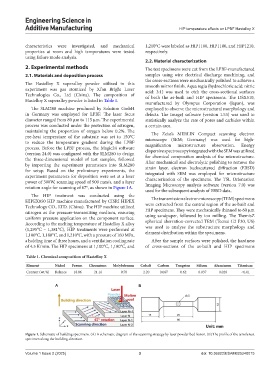
            rotation angle for scanning of 67°, as shown in Figure 1A.
                                                               used for the subsequent analysis of EBSD data.
              The HIP treatment was conducted using the
                                                                 The transmission electron microscopy (TEM) specimens
            HIPEX850 HIP machine manufactured by CISRI HIPEX   were extracted from the central region of the as-built and
            Technology CO., LTD. (China). The HIP machine utilized   HIP specimens. They were mechanically thinned to 60 μm
            nitrogen as the pressure-transmitting medium, ensuring
            uniform pressure application on the component surface.   using sandpaper, followed by ion milling.  The ThemisZ
            According to the melting temperature of Hastelloy X alloy   spherical aberration-corrected TEM (Tecnai G2 F30, US)
            (1,295°C  –  1,381°C),  HIP  treatments  were  performed  at   was  used  to  analyze  the  substructure  morphology  and
            1,100°C, 1,180°C, and 1,210°C, with a pressure of 160 MPa,   element distribution within the specimens.
            a holding time of three hours, and a ventilation cooling rate   After the sample surfaces were polished, the hardness
            of 4.5 K/min. The HIP specimens at 1,100°C, 1,180°C, and   of  cross-sections  of  the  as-built  and  HIP  specimens
            Table 1. Chemical composition of Hastelloy X

            Element     Nickel  Ferum  Chromium  Molybdenum  Cobalt  Carbon  Tungsten  Silicon  Aluminum  Titanium
            Content (wt.%)  Balance  18.86  21.16   9.78      2.20   0.067    0.62   0.037    0.028     <0.01

                         A                                  B


            Figure 1. Schematic of building specimens. (A) A schematic diagram of the scanning strategy by laser powder bed fusion. (B) The profile of the tensile test
            specimen along the building direction.


            Volume 1 Issue 2 (2025)                         3                          doi: 10.36922/ESAM025240015

